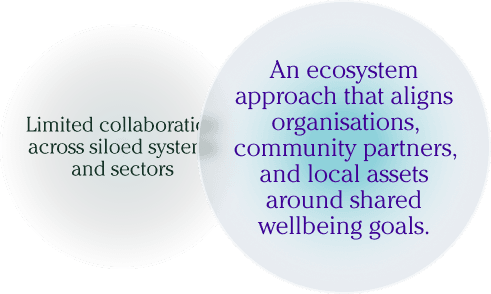
Building for Life Rhythms explores how contemporary social and economic systems shape wellbeing, and why many working adults experience chronic stress and burnout despite being “functioning.” The project examines how dominant ideologies prioritise productivity, efficiency and self-reliance, often at the expense of care, rest and relational support.
Institution
MA Service Design, University of the Arts London
Course Unit
Final Major Project
Year
2025
Project Context
Postgraduate Project
This project examines how social expectations around productivity, resilience and individual responsibility shape the way people understand and access care. Many working adults move through life with fluctuating conditions, burnout, caring roles or major transitions that do not meet formal thresholds for support. These experiences often remain unseen or invalidated because current systems are designed around diagnosis, crisis and the idea of the ideal worker.
Using relational and participatory methods, the project centres lived experience as a source of insight. Conversations, codesign and community engagement were used to explore how people negotiate their wellbeing within structures that were not designed for them. These approaches draw on the social model of disability, relational welfare and ecological perspectives that see health and care as shaped by the environments people inhabit.
The outcome is Care for All, a preventative and place-based service concept that embeds support within workplaces. It offers early intervention, flexible rest pathways and low-barrier access to wellbeing without requiring proof, labels or crisis. By linking workplaces with local health and community networks, the service imagines a culture of care that is shared, accessible and part of daily life rather than something reserved for emergencies.

Care for All is a place-based wellbeing service embedded within workplaces. It expands, enhances, and streamlines existing care systems by making them accessible through a single touchpoint - Wellbeing Personnels located directly in the workplace.
These Wellbeing Personnels improve access to support by co-producing Personalised Wellbeing Plans with employees at the start of their employment, which can be reviewed and adapted over time. Rather than waiting for crises to occur which is a reactive, “fixing” approach, the service adopts a preventative model, supporting individuals to sustain healthier and more sustainable life rhythms.
The service also champions shared decision-making and promotes individual agency through the JoyforMe platform that enables employees to take an active role in managing their wellbeing and to stay connected with a system of care that moves in sync with their lives.
THE CHALLENGE
Structural Constructs
Wellbeing & Social Constructs
Wellbeing is deeply influenced by social constructs embedded in how we work, live and relate to one another. Contemporary societies often privilege competition, hierarchy and economic growth, reinforcing long working hours, inflexible work cultures and the erosion of community spaces. These conditions disrupt natural life rhythms and disproportionately affect those navigating caregiving, health conditions, financial precarity or life transitions.
Burnout emerges when these pressures accumulate over time without adequate support. While widely experienced, burnout is poorly recognised and often dismissed until it escalates into crisis. Many people delay seeking help because they do not feel “ill enough” or believe they must cope alone, allowing stress to intensify quietly and invisibly.
Across many countries, wellbeing remains secondary to economic output. Broader inequalities related to income, housing, gender, disability, and ethnicity continue to shape health and quality of life. Recognising the social and economic value of care, and challenging systems that pushes for productivity over people, is essential for designing more inclusive and equitable futures.
Economic Output Over Wellbeing
Economic systems prioritise measurable productivity over wellbeing, leading to the systematic undervaluation of unpaid care work. This work, largely carried out by women, is essential to societal functioning yet remains invisible in economic assessments, reinforcing gender inequality and limiting progress toward a more inclusive and equitable economy.
Long Working Hours & the “Ideal Worker” Myth
The glorification of the “ideal worker” promotes an unrealistic model of total dedication to work, free from caregiving or personal responsibilities. This norm reinforces long working hours, disadvantages those with caring duties, and places disproportionate pressure on women, contributing to burnout, career penalties and strained personal relationships.
Perpetuation of Unrealistic & Harmful Expectations
Patriarchal norms that equate emotional restraint with strength discourage vulnerability and help-seeking. This fosters emotional repression, weakens social bonds and contributes to loneliness, increasing the risk of mental health challenges and eroding collective wellbeing.
Life Rhythms
Life rhythms, in essence, are the patterns and routines that structure and give shape to our daily lives. They can be natural, arising from internal needs or external influences, and they can be either helpful or detrimental to our well-being. Essentially, a life rhythm is the way we organise our time, activities, and relationships to create a sense of balance and predictability.
Dimensions of wellbeing & factors of influence
Cardiologist Desai (2024) outlined key aspects of our holistic wellbeing that are crucial to maintain in order to thrive and lead fulfilling lives:
Social Connections
Encompasses social interactions, building and maintaining meaningful connections, sense of community and belonging.
Emotional Balance
Mental Wellbeing
Encompasses practices that enhance cognitive function, promote mindfulness, and manage mental health challenges to enhance mental wellbeing.
Physical Health
Encompasses our nutrition, exercise, sleep, and preventive health measures for optimal bodily function and vitality.
Spiritual Wellness
Involves personal values, beliefs, and practices that nurture our spirit to fosters inner peace, resilience, and a sense of purpose.
A person’s life rhythm can be influenced by many intrinsic, internal and external factors. These are a combination of nature (biologically or genetically) and nurture (the experiences and environmental influences).
Emotional & Psychological Rhythms
Biological Rhythms
Everyday Rhythms
In this project, a combination of these dimensions and factors were referenced to create a set of wellbeing facets to facilitate conversations and research.
Most cities and social systems are built on values associated with patriarchal power such as competition, productivity, extraction, and hierarchy (Gilbert et al., 2024) over traits that more often aligned with matriarchal or feminist frameworks collaboration, emotional intelligence, and relational forms of power (Plank, 2025). As a result, systems and public services tend to undervalue social cohesion, community care, and the everyday rhythms of life that sustain people (Visakha, 2023).
Burnout
Burnout is widely experienced but poorly addressed. Many people delay seeking support until they reach crisis, often because they do not meet eligibility thresholds, fear stigma or cannot navigate fragmented care systems. Existing support structures tend to be reactive, difficult to access and disconnected from everyday environments such as workplaces, where stress often accumulates.
At the same time, healthcare and community services are overstretched, leaving little capacity for preventative care. This creates a gap where individuals exist in “in-between” states: not unwell enough for intervention, yet not supported enough to thrive.

Even though burnout is extremely prevalent, it is often misunderstood, stigmatised and not taken as seriously compared to other conditions as exemplified by its medical recognition and access to treatment.
Burnout is not a condition that resolves itself over time. In fact, it can worsen and lead to chronic health conditions, both physical and mental such as depression or heart disease (Mental Health UK, n.d).
Those experiencing it may resort to drastic and unhealthy coping mechanisms such as substance misuse and if they reach a breaking point, they may take drastic actions such as quitting their job regardless of financial repercussions.
This is shown in the data captured by the Burnout Report where 21% of workers needed to take time off work due to poor mental health caused by pressure or stress.
It evolves into a vicious cycle when that affects their work performance, as shown with the 85% of the survey responders that said their work was impacted.

The causes or contributing factors are commonly assumed to be strictly work-related. However, many this is not always the case as external and everyday stressors can also exist simultaneously and compound, exacerbating burnout symptoms. A holistic understanding of burnout must therefore recognise the full ecosystem of factors that shape a person’s daily life.

Within workplaces, the report found that almost half of employers (45%), do not have structures in place to identify or prevent burnout (Mental Health UK, n.d.). It also showed that 32 percent of workers do not feel comfortable disclosing their stress levels at work (Mental Health UK, n.d.).
As a result, many struggles remain unseen and can escalate when left unmanaged. The consequences are evident, as 21 percent of workers reported taking time off due to declining mental health linked to pressure or stress (Mental Health UK, n.d.).


The three themes explored in this background show how closely wellbeing is tied to the conditions people live in. Structures that form our society either support or constrain our ability to thrive, and often, many feel pressure to maintain rhythms that do not match their actual capacity.
Burnout happens when these pressures accumulate without space for recovery. The tell-tale signs of burnout are often missed as it manifest through a slow, but gradual, erosion of energy. Competing demands and limited room to pause can exacerbate the condition, leading to drastic outcomes. Together, these factors illustrate how social expectations, disrupted rhythms and sustained overload interact to undermine wellbeing.
By adopting care-based approaches, re-centering care in society, strengthening social connections, and designing systems that honour the diversity of human experience, it becomes possible to imagine more compassionate and sustainable models of wellbeing.


APPROACH
Research Methodologies
Grounding Methodologies
The human experience is fluid and is shaped by life events, transitions, and interdependent circumstances. Drawing on these theories and methodologies, difference is not seen as deviation, but as variation across time and context.
This understanding forms the foundation of a relational methodology that values ongoing dialogue and co-creation, rather than fixed categories of need.
In grounding working relational welfare and care ethics, the project frames research as a collaborative process of mutual learning and adaptation that is attuned to the lived rhythms, uncertainties, and transformations that define everyday life.
The grounding methodologies guide both the process and the outcomes. It includes shaping how research is conducted, how insights are gathered, and ultimately, how the service is envisioned.
This project is grounded in relational, feminist, and critical disability methodologies that view care, difference, and participation as central to design. Instead of sticking to the status quo of deficit-based models, it instead positions diversity and interdependence as structures of collective resilience. These approaches shape each stage of the process through care, dialogue, and co-creation.
Difference is relative and not a defect
Recognising Difference as Knowledge
Neurodiversity Paradigm
Social Model of Disability
Crip Theory (Critical Disability Studies)
Embracing life rhythms
Life-Course and Temporal Perspectives
Relativism and Otherness
Life Course Theory
With, not for
Relational and Care-Based Methodologies
Situated Knowledge and Epistemology
Capability Approach
Guiding Principles
These perspectives inform the direction of knowledge-building and participatory methods where inquiry takes the form of mutual exchange rather than extraction.
As a result, these intersecting theories formed three guiding principles to shape every stage of the research and engagement.
Collectively, these methodologies form a relational-feminist epistemology in the way knowledge is understood as situated, partial, and co-produced. Inquiry manifest as the act of care through ongoing conversation that values lived experience as both knowledge and method.
Guiding Principle
Care as a Research Value
Feminist and Relational Welfare Traditions
Care acts as both a thematic focus and a guiding research value that shapes the way knowledge is produced, relationships are formed, and insights are interpreted. In this process, care represents an ethical and relational stance that centres respect, reciprocity, and attentiveness to others’ realities.
Practicing care as a research value means approaching every step of the process with sensitivity to participants’ contexts and emotional wellbeing, rather than treating them as data points or subjects of inquiry. Therefore, Care is used as a methodological tool for slowing down, listening deeply, and remaining reflexive about power dynamics between researcher and participant.
The principle encourages design with, not for, communities. This acknowledges that trust, time, and reciprocity are prerequisites for meaningful collaboration, but also challenges traditional design paradigms that privilege efficiency, scalability, or innovation over human wellbeing.
Provocation
What would it mean to design a process where care matter more than output?
Embodiment into Practice: Reflexivity
Positionality Statements
Acknowledging biases and positionality is a practice of honesty and accountability. Donna Haraway’s notion of situated knowledges and feminist standpoint theory both call for transparency in the researcher’s own standpoint (Haraway, 1988).
Iterative Feedback Loops
Returning to participants throughout research ensures accountability (Kesby, 2005), countering the one-off “consultation” model. Feedback loops ensure that findings are not “taken away” but continually checked and re-shaped with participants.
Check-ins
Check-ins make the often implicit process of reflection explicit and actionable. As a researcher, it is an obligation to attend to an ethic of care for the participants of the project. This can include actions such as acknowledging and reflecting, and demonstrating care through active dialogue and understanding (Mills, et al., 2010).
Guiding Principle
Fostering Solidarity, Not Aid
Matriarchal and Asset-Based Approaches
The project should seek to aim for meaningful change through collaboration and interdependent exchange of knowledge instead of a one-directional flow of help, from those with power or resources to those who do not.
To foster solidarity, we need to move away from seeing communities as beneficiaries, and instead towards them as co-creators and collaborators. This reframes care not as charity but as collective responsibility.
Provocation
How do we resist diluting or professionalising those voices for academic legitimacy?
Embodiment into Practice: Collaboration
Cocreation
Co-creation is practiced as a relational practice where participants become active contributors, not passive informants. It moves beyond consultation by inviting people to shape the direction, meaning, and possibilities of the work alongside me. Co-creation recognises that expertise is distributed, held in lived experiences, community knowledge, and everyday navigation of systems.
Participatory Design
Participatory design underpins this project as an approach that centres people in decisions that affect their lives. Design is treated as something done with communities rather than delivered to them. This approach acknowledges that people hold valuable knowledge about their own contexts and that meaningful change requires their involvement throughout the process. This ensures the outcomes are grounded in real needs, aspirations, and lived realities.
Guiding Principle
Championing Lived Experience as Expertise
Feminist Standpoint and Social Model of Disability
Participants are recognised as knowledge holders whose lived experiences are acknowledged as expertise. Traditional systems of research often prizes institutional, academic, or professional authority, while overlooking the deep, situated knowledge held by individuals that navigate complex realities in their daily lives (Hesse-Biber and Leavy, 2007).
Their insights, emotions, and everyday experiences are treated as forms of knowledge that reveal the nuances and contradictions of how systems actually function (Haraway, 1988). This aligns with participatory and feminist research traditions which recognise that those closest to an issue often hold the richest understanding of it.
In practice, this means creating conditions where participants can safely and confidently articulate their experiences such as open-ended and loosely structured set-ups.
By centring lived experience as expertise, the project challenges the assumption that knowledge must factual or objective to be credible. Instead, it recognises that empathy, emotion, and embodiment are also ways of knowing that is essential for designing services that are grounded, inclusive, and truly responsive to human life.
Provocation
What does it mean to stand with, rather than stand over?
Embodiment into Practice: Conversations
Creating Conversational Spaces
Loosely structured exchanges where participants takes part to shape the agenda instead of extractive traditional methods of research and interviews as critiqued by feminist methodologies. Research should take the form of dialogue, mutual exchange, and co-shaped conversation.
Encouraging Storytelling
Narrative and storytelling methods also foreground voice and context, resisting reduction to data points. This inquiry approaches that demonstrate how storytelling resists fragmentation and centres communal voice, meaning, stories become ways of knowing and not just datapoints.
RESEARCH
Discovering the People
Initial Questionaire
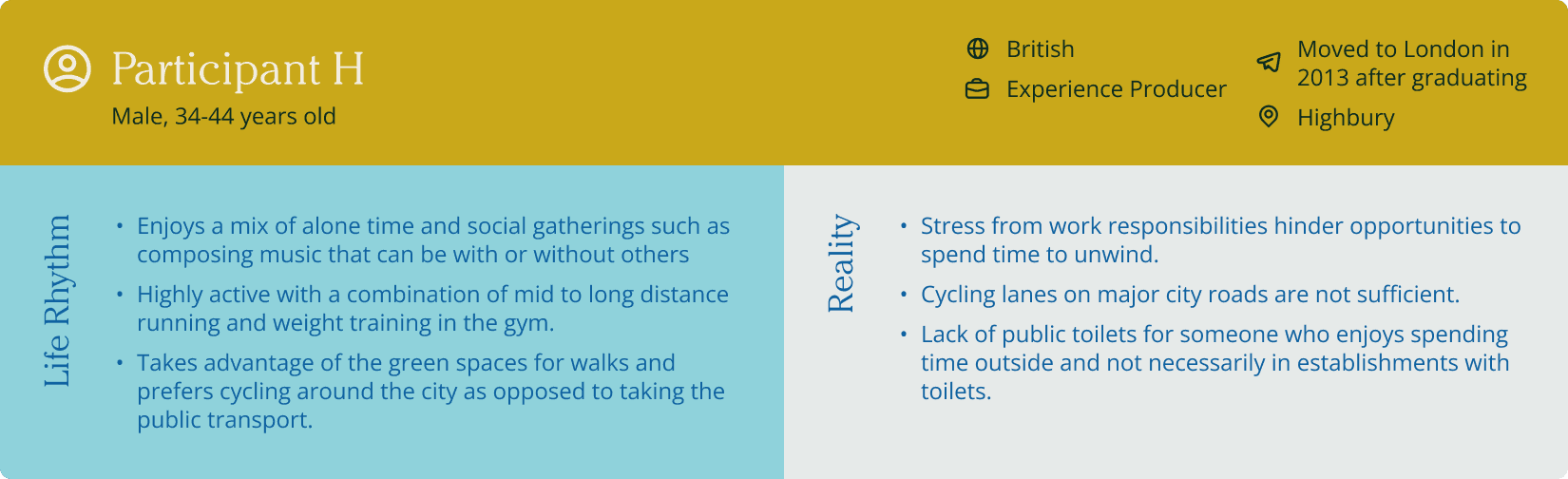
An initial survey was sent out to a selected participants to understand the experiences of working adults in London with regards to their wellbeing and how their current life aligns or disrupts their life rhythms.
The common struggles faced by these participants are stressors from work and environmental mismatches which limits when and how they can feel relaxed and at ease. Often, these external factors are not something they find are within their control and they relent to the life they have.
Based on the understanding that professional responsibilities have a huge influence on their wellbeing and these workers often feel out of sync, I delved into understanding the background and context and break down the factors of wellbeing through in-person and personal conversations.


Conversational Spaces as Research
At the core of this research are conversational spaces as guided by the project principles. These moments allowed individuals to speak from lived experience rather than within the constraints of a formal interview. In these slower, more human spaces, stories unfolded naturally, something that may not happen in traditional extractive methods.

Conversational Tools: Wellbeing Cards
To aid conversations during these sessions, conversational cards were shared to ease the thinking process of the participants. These cards each display a dimension of wellbeing, along with descriptions and examples.


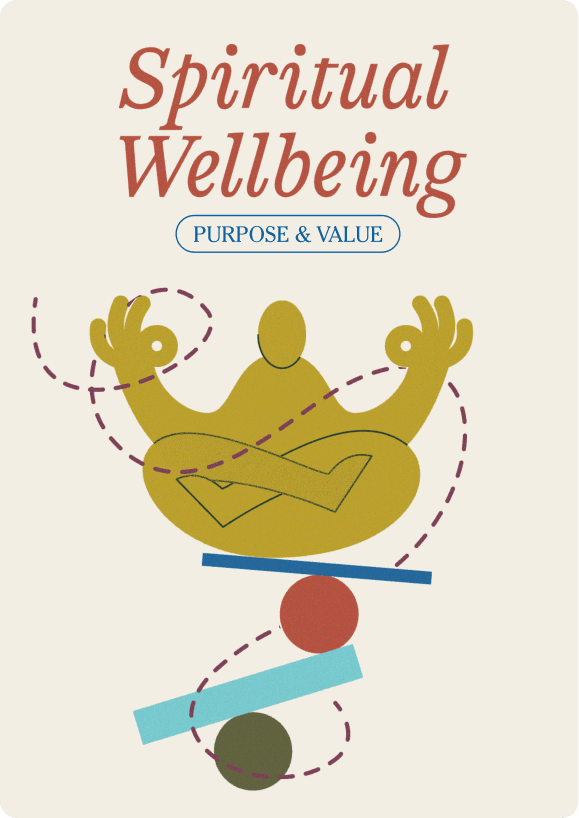


While there are many interpretations of the factors that makes up an individual’s holistic wellbeing, the seven areas that were eventually used were a combination of Debbie Stowen’s eight dimensions of wellness, the UK’s 10 topic areas of measuring national wellbeing, and the seven types of rest developed by Saundra Dalton-Smith.
Conversation Structure
A loose conversational structure helped participants warm up and ease into opening up. Instead of rigid questions, the discussions began with simple ‘ice-breakers’ that let them describe their routines, pressures, and moments of pause in their own way. This flexible approach aligned with the project’s principles of care and relationality, allowing their life rhythms to emerge organically through conversation.


Participant A
Previously transitioned from full-time employment to part-time at the design agency she works at after enrolling into a postgraduate programme.
Financially independent supports herself. Family lives abroad and she helps them with administrative matters.
Juggling part-time work and financing her postgraduate programme
Manages all living costs independently and is not reliant on her parent.
Moving towards a new career path in her 30s.
Recently stabilised housing situation after frequent moves.
Supports mother with financial and legal paperwork (taxes, investments).
Acknowledges that environment and weather strongly impacts her wellbeing and productivity.
Online, calling in from her office
Over lunch break
Participant B
Work full-time remotely, albeit with changes to workload
Juggling many stressors at once
Financially independent and also responsible for his family back in his home country
Has a full-time remote employment that he juggles with full-time postgraduate studies.
Relocated to London
Juggling many responsibilities and burdens that requires his attention at all hours.
Supports and cares for family back home.
Enjoys quiet environments and green spaces but his busy schedule and inconsistent working hours limits those.
In-person
Participant C
Currently interning at an agency (unpaid) while he pursues his postgraduate studies.
He feels a lot of pressure for the future once his postgraduate studies end as he has to financially support himself and secure a visa to remain in the country.
Faces financial stressors that are execrated by his student status and conflict with family.
Relocated to London with aims to build a life here.
Relationship conflicts and identity affects his wellbeing
NA
Thrives in London for its social and environmental factors
In-person
Participant D
Previously worked in London but have since left that to continue postgraduate studies. She also has unpaid internship to build her portfolio.
Participant left her home country and was working in London through the pandemic where she struggled with loneliness. The lack of familial and community support contributed to her degrading mental health.
Feels constrained by employment due to her need for income to afford her fixed-term rental that she was locked in.
Left her family and country to relocate to London.
Lived through the COVID lockdown right after starting a new job and new tenancy in a new country.
Transitioned to pursuing a postgraduate degree
NA
Remote work during pandemic lockdown led to isolation
Difficulties making friends and finding open, reciprocal social spaces
In-person
Crocheting during the session
Participant D previously participated in the initial questionnaire.
Participant E
Working in a creative agency as a design lead, managing the entire design team.
Been experiencing work-related pressures for extended periods of time
NA
Sustained pressure and emotional fatigue from work
Significant shift in her workload with new hire
NA
Makes intentional plans to pick up hobbies and cycle more often
Alcohol-centric and repetitive social culture in London limits meaningful connection.
lacks space for creativity or rest, causing disconnection from her sense of self
Online
Held during the weekend when she is less busy
The participant previously participated in the initial questionnaire and was approached again for a conversation to understand her situation more in-depth.
Insight from Conversation Sessions
The conversations had many overlaps and similar themes that plagued these working adults. Holding the sessions in a one-on-one format allowed each participant the space to form their thoughts and be more candid without fearing judgement. Not having to wait their turn to speak also allowed them to speak at their own time and pace. This meant that the participants can detail on their feelings and reflect of the problems and issues they were facing.
In addition to what the participants shared, I also observed the ways these participants chose to deal with their stressors, their headspace and mindset, and their view asking for help or support.
Across the participants, those in the grey zones of wellbeing feel unseen, unsupported, and undeserving of help, even while carrying significant emotional, financial and environmental burdens. They rely on self-management and patchwork community support because existing systems only respond at the point of crisis. What they want instead is a more flexible, humane, relational culture of care embedded into everyday life and work.
Overlapping Themes
Support systems are fragmented, invisible, and hard to access unless you are in crisis
Psychological barriers and self censorship
Life transitions and instability are major accelerators of burnout
Community is the strongest protective factor, but access varies
Financial and employment precarity shape wellbeing more than any other factor
Community Spaces as Research
A core methodology of the project is embracing lived experiences and giving individuals the space to share in a safe and non-judgemental space. Aside from organising one-on-one sessions with participants, often these dialogs are already happening around us through support groups and organisations.


The Carers Centre Tower Hamlets (CCTH) is a key voluntary organisation in the borough, providing support to unpaid and informal carers. In conversation with their Volunteer Manager, Tony Collins-Moore, it became clear that the centre actively engages a group of Carer Champions. This a network of carers whom they regularly consult and co-design with. This participatory approach is also embedded in their funding requirements, ensuring that services are shaped by those with lived experience.
Tony also highlighted that many carers are heavily stretched, often juggling multiple responsibilities, while some communities remain hard to reach due to language and cultural barriers.

The challenges CCTH faces strongly intersect with the themes emerging in this project, particularly around access, overload, and the need for preventative support. This alignment presents a valuable opportunity for knowledge exchange, where insights from the centre, their carers, and my service design expertise could work together to generate positive impact for their ongoing work.

The London Autism Group Charity (LAGC) hosts monthly Community Cafés that provide autistic individuals with a safe and inclusive space to meet, connect, and share experiences (London Autism Group Charity, n.d.). The sessions are intentionally designed to accommodate the spectrum of needs: some groups engage in conversation, while others take part in quieter individual activities, ensuring that participation is entirely on each person’s terms.
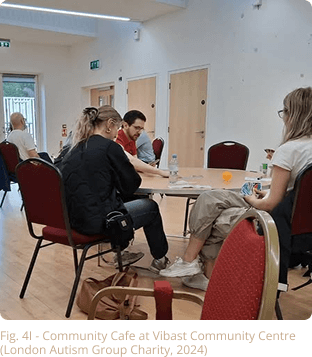
At one table of around eight participants, a diverse mix of voices was present including newly diagnosed adults, those diagnosed later in life, long-diagnosed autistic individuals, as well as neurotypical volunteers. This created a rich exchange of lived experiences and perspectives.
A new attendee, a woman in her 50s, shared particularly significant reflections. She described the exhaustion of masking and how, after menopause, maintaining that façade became impossible. She has struggled to hold onto jobs and is a mother of two adult children, one of whom has Bipolar Disorder. She expressed feeling that she is expected to mask more heavily, compared to how autistic men are often granted more leeway for visible autistic traits and behaviours. She said she processes information slowly, needs more time to learn and understand tasks, and is unaware of the workplace adjustments she is legally entitled to request. She also shared that she has never met anyone “like her,” which has contributed to deep feelings of isolation.
Another attendee, a man in his 20s, shared that he had previously been depressed and highly introverted. Since joining the community, he has become more confident, more willing to socialise, and has even begun travelling. For him, having a space where he feels understood and not judged has been transformative, expanding both his social world and outlook.
Together, these experiences highlight the profound role that community plays in individual wellbeing. Supportive social environments can reduce isolation, offer validation, provide models of lived experience, and create openings for personal growth. In situations where formal systems often fall short, particularly for non-visible conditions like neurodivergence, community-led spaces can act as supporting factors. They offer continuity, belonging, and everyday forms of care that formal services rarely provide.

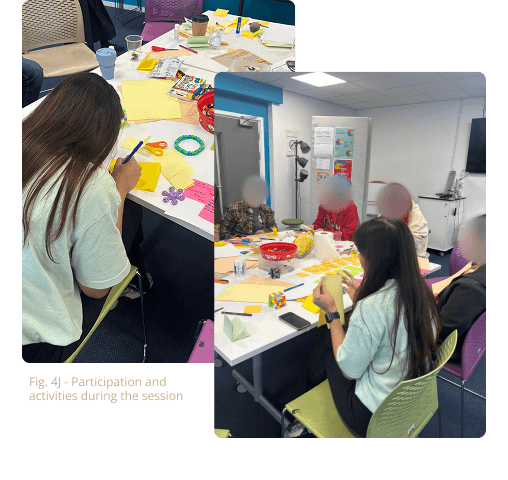
The Neuroinclusive Play Collective brings together neurodivergent postgraduate and PhD students through play in a safe and judgement-free space where masking can drop. In the early October session, participants used prompts and playful activities to reflect on how their neurodivergence shapes their daily lives, rhythms and responsibilities.
Most attendees had previously worked full-time before returning to postgraduate study and many described how those working years were filled with quiet distress and undiagnosed needs. Several shared that, at the time, they did not recognise their challenges as neurodivergence, and instead, they internalised them as personal failings.
One participant shared that they carried caregiving responsibilities alongside studies and work. These additional pressures often intensifies burnout. Also, many described living in a state of heightened alertness, overstimulation, or exhaustion.
Each individual in the group shared a common experience of carrying invisible struggles that went unnoticed in traditional academic or work settings. The session exercises revealed recurring themes such as procrastination that was actually executive dysfunction, overstimulation during commutes, sensory overwhelm in social settings, perfectionism driven by anxiety, difficulty voicing needs, disrupted routines at home, and the constant mental load of managing small admin tasks that accumulate into burnout. The attendees spoke about masking, overthinking, rigid internal standards, and the pressure to perform normality. Several mentioned feeling guilty for needing rest, struggling to keep up with the speed of their peers, or feeling out of sync with societal expectations.
The mapping activities showed how these challenges appear across all domains of life, from home, to personal interactions, to professional and academic settings.
Insight from Community Spaces
Across the three communities, people share a similar experiences with invisible pressures, system fatigue, and chronic emotional and cognitive load. They are expected to navigate complex support systems while already depleted. Belonging, clarity, relational support, community understanding, and structures proved to be paramount to improving their wellbeing.
Their experiences highlight the need for a more compassionate, integrated, and preventative approach that recognises the everyday realities of diverse life rhythms.
People delay seeking help because they do not feel “ill enough” or “legitimate enough”
Across the three communities, there is a consistent pattern of self-minimising. This stems from stigma, cultural narratives, and internalised expectations, resulting in prolonged struggle, isolation, and burnout .
Invisible struggles shape daily life but are rarely recognised by systems
Across all three groups, participants described internal pressures that are not easily visible from the outside. People often appear “fine” externally, yet internally juggle complex unmet needs. These struggles are usually dismissed or overlooked because they do not fit traditional indicators of crisis.
Systems feel overwhelming and hard to navigate
All three communities highlighted the same problem of fragmentation. Often, support exists, but it is scattered across various departments that do not communicate with each other. This creates creates added cognitive, emotional, and physical labour to the individuals who are already depleted.
Community spaces provide more meaningful support than formal systems
Community spaces create belonging and offer mutual care that formal systems cannot replicate. Also, community-based support is more accessible, less intimidating, and more responsive than institutional pathways.
RESEARCH
Discovering the System
National Health Services (NHS)
More commonly referred to the NHS, the National Health Services (NHS) is a publicly funded healthcare system in the United Kingdom (NHS England, N.D.).
To identify strengths and weaknesses, opportunities and gaps, and areas of intervention, the system of the NHS was studied to discover existing structures in place and the touch points of patients with regards to wellbeing.
This project will focus specifically on NHS England (NHSE) to look at the health and care systems in Tower Hamlets.
NHS Long-Term Plan
The three big shifts to the existing system:
1
From hospital to community
2
From analogue to digital
Leveraging their robust database and extensive network, the NHS app will be redesigned to increase digital accessibility and care just a tap away. Additionally, the technology will increase patient’s control over their data and record.
3
From sickness to prevention
Boost overall health of the nation by halving the gap in healthy life expectancy extreme ends of the population through preventative steps that will reduce illness and diseases across all stages of life starting from newborns.
NHS Long-Term Plan
The plan also details on how these shifts are carried out, with big changes to the operating model and workforce, and using innovation and technology to increase transparency and standards of care (Department of Health and Social Care, 2022).
Through a new operating model
Through a reshaped innovation strategy
By ushering in a new era of transparency
Different approach to NHS finances
What it means for patients
The overhaul looks at the impact it will have on the patient experience. While their strategy and direction may be reshaped over the years, the changes to the structure and workforce are still intended to enhance the end users’ experience with the their taxes funded.
Making sure everyone gets the best start in life
From pregnancy, to childhood, the plan aims to improve areas such as supporting expectant mothers, tackling childhood obesity, reducing waiting times for autism assessments, delivering the best treatments available for paediatric cancer.
Delivering world-class care for major health problems
Prevention on conditions like cardiovascular diseases through education and exercise programmes, reduction in cancer deaths through early detection, increased spending to tackle mental health, and delivering more community-based physical and mental care.
Supporting people to age well
Supporting mechanisms such as increasing funding for primary and community care, promote independent living at home for longer, developing faster community response teams, and giving geriatric patients more agency towards end-of-life stages.
Integrated Care Systems (ICSs)
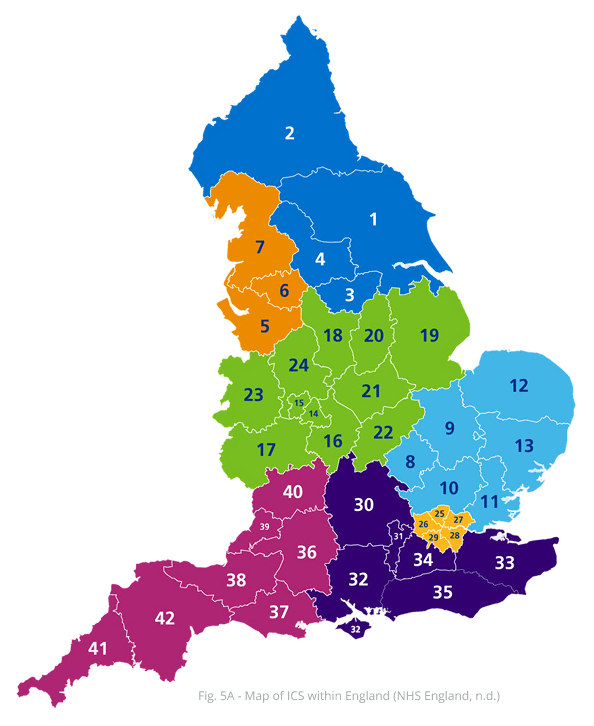
One of the biggest structural changes is the transformation of the Integrated Care Systems (ICSs). Originally conceived in 2014 in the NHS Five Year Forward View, the system have since taken shape over the years, with major updates during the launch of the Long Term Plan in 2019 (NHS England, n.d.). In 2021, it finally became effected in all 42 parts of England (NHS England, n.d.).
The purpose of this system is to develop a place-based and more connected health and care system that joins the various services such as General Practitioners (GPs), and social care (NHS England, n.d.). This is also to address the complex conditions people are living longer with, meaning that care has to go beyond access to good quality healthcare (NHS England, n.d.).
In 2022, ICSs were further solidified with the passing of the Health and Care Act 2022, giving them statutory status, meaning that ICSs are legally obligated to provide services to its people (NHS England, n.d.).
Integrated Care Boards (ICBs)
Integrated Care Boards (ICBs), however, are the committee that are responsible for managing health services for their local area within their ICS (NHS England, n.d.). They are a key component of the ICS that deals with the negotiation, finances, and health outcomes (NHS England, n.d.).
Universal Personalised Care & Social Prescribing
One of the LTP commitment is the Universal Personalised Care, which aims to give people the same choice and control over their health the same way they do with other aspects of life. This is a huge step away from the old ‘one-size-fits-all’ health and care system which cannot meet the increasing complexity of needs (NHS England, 2019).
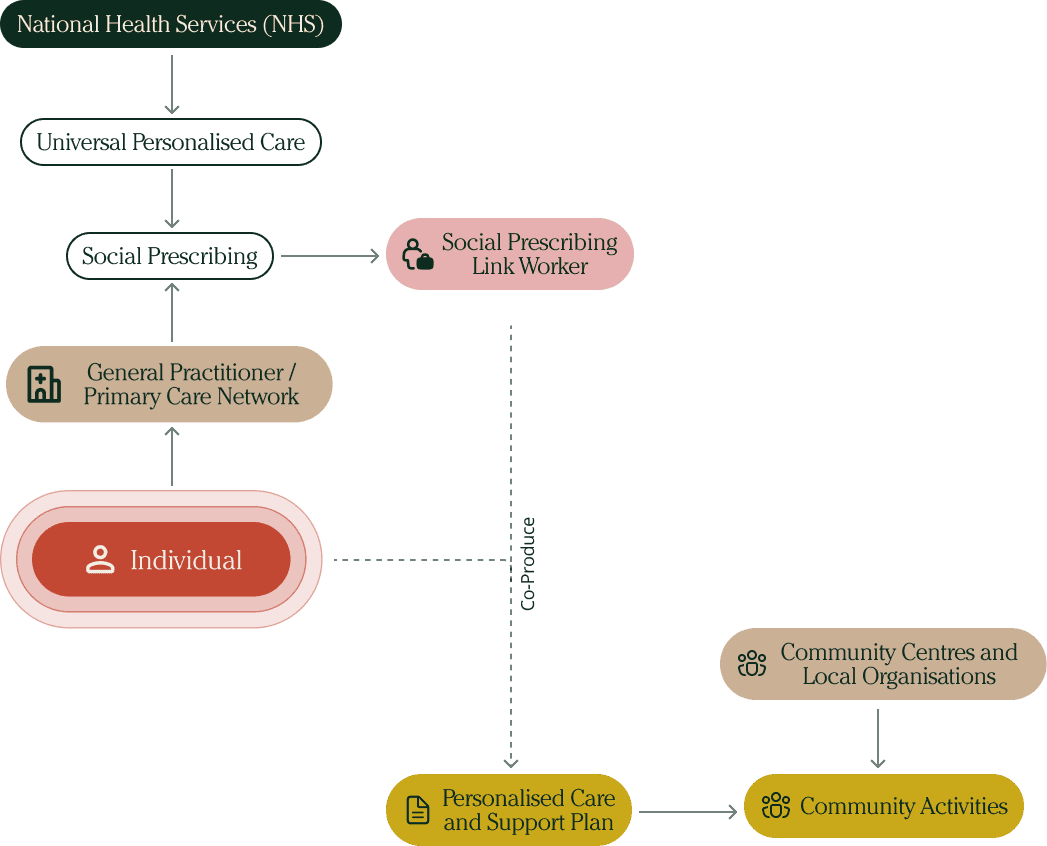
Social Prescribing is a community-based support that is provided through primary care network (PCN) services (NHS England, n.d.) whereby the patient is referred to a Social Prescribing Link Worker (SPLW) to coproduce a personalised care and support plan that is a plan that focuses on what matters to the patient (NHS England, n.d.).
This is suitable for those who have one or more long term conditions, need support with low level mental health issues, feels lonely or isolated or have complex social needs (NHS England, 2020). In turn, this alternative treatment helps to free up space in medical centres such as hospitals.
This pathway connects people to community groups for emotional support that can lead to positive health and wellbeing outcomes for them (NHS England, 2020). This can also be seen as a preventative action that reduces the likelihood of these individuals developing more severe illnesses or diseases that may plague the health and care system down the road.
The LTP laid plans to erect the infrastructure to embed this social prescribing and community-based approaches across the NHS, with incrementally more individuals being able to access the service every year (NHS England, n.d.). In 2022/2023, it was made contractually mandatory for PCNs to proactively provide the service (NHS England, n.d.).
The National Academy for Social Prescribing (NASP)
The academy is an organisation that champions Social Prescribing. They support SPWL with resources and signposting to other organisations. They also piloted the Link Worker Advisory Group for SPLW to be consulted and also discuss issues at local level (National Academy for Social Prescribing, n.d.).
NASP also recruits Social Prescribing Champions to enhance peer networking and promote Social Prescribing in their area or workforce (National Academy for Social Prescribing, n.d.). However, this role is only open to individuals who work in healthcare-related settings or are qualified to provide healthcare services to patients (National Academy for Social Prescribing, n.d.), and it does not come with the training to be a Link Worker.
National Centre for Creative Health (NCCH)
The National Centre for Creative Health (NCCH) powers the creative health approach by supporting a network of Creative Health Champions who are key leaders within health and care systems (National Centre for Creative Health, n.d.). These individuals are typically those who have held the most senior Board Level roles in the sector, however, the organisation acknowledges that embedding Creative Health throughout the system requires leadership at all levels, welcoming other leaders to join as well (National Centre for Creative Health, n.d.)..
The Creative Health Champions network was developed as a result of a 2017 report by the All-Party Parliamentary Group for Arts, Health & Wellbeing (APPG) to respond to one of the ten recommendations to enforce institutional policy for arts, health and wellbeing at board or strategic level (National Centre for Creative Health, n.d.).
Creative Health
The registered charity defines Creative Health as creative approaches and activities that benefits the health and wellbeing, and in the long-run, aids the prevention of ill-health . These could be performing arts or gardening and can be applied even at home. In the long-term, this aids the prevention of ill-health and promotes better lifestyles and management (National Centre for Creative Health, n.d.).
Tools and Integration
NCCH works with ICSs across the country to co-developed a Creative Health Toolkit that supports programmes likes Social Prescribing (Creative Health Toolkit, n.d.).
They have also delivered the Creative Health Associates Programme through representative ICBs including the North East London ICB. The purpose is to integrate creative health into the ICB, enhance its role in Social Prescribing, increase Creative Health approaches, and improve cross-sector understanding of it (Creative Health Toolkit, n.d.).
10-Year Workforce Plan (part of the NHS 10-Year Health Plan)
Much more recently, in September 2025, the organisation shared the actions taken that aligns with the the NHS’ vision such as:
Adopting digital tools and platforms to create dual pathways to improve access and management,
Decentralising the system to embed Creative Health practices within communities such as the role of Champions and Associates, and
Deliver preventative care services as a natural result of their Creative Health approaches (National Centre for Creative Health, n.d.).
They also shared evidence of the benefits of their approaches and the impact it has on improving the health and wellbeing of the people. For example,
a 40% reduction in GP appointments from those who underwent Social Prescribing focusing on cardiovascular diseases risks and mental health,
reduction in paediatric patients’ asthma symptoms after attending music therapy, and
evidence of brain simulation that is linked to emotional processing and regulation, when engaging with creative arts stimulates parts of the brain linked to (National Centre for Creative Health, n.d.).
Agile and Responsive
As part of their commitment, Change NHS was launched in October 2024 as the biggest conversation and co-developing efforts on the future of the NHS. This was so that members of the public, healthcare staff and partnering organisations can be part of contributing to this change. This is one of many promising initiatives that showed their pledge for development through approaches like shared decision making.
Over the years, the strategy have evolved and adapted to the changing needs to address urgent and relevant issues. Each year, a Priorities and Operational Planning Guidance is released to outline and detail on the strategic priorities for the NHSE and Integrated Boards (ICBs). The main areas that are covered are:
Core Service and Performance Targets
Elective Care and Waiting Times
Urgent and Emergency Care
Cancer Standards
Primary Care and Diagnostics
Financial Stability and Productivity
Financial Goals and Accountability
Efficiency & Cost Reduction
Financial Framework Changes
Systems Working and Digital Transformation
Integrated Care System Development
Neighbourhood Health Service Models
Digital and Data Infrastructure
Workforce Quality and Health Equity
Workforce & Staff Experience
Health Inequalities & Prevention
Maternity & Quality
Specialised Services Access
A few years after the launch, national guidance repositions LTP as the “north star” while focusing on recovery and inequalities, and strengthens Social Prescribing (NHS England, 2023).
The latest release for 2025/2026 (NHS England, 2025) highlighted:
Reducing waiting times for Elective Care
Target to achieve 65% of patients waiting no longer than 18 weeks (from 65 weeks from the previous release) for elective treatment as a core national priority and a crucial stepping stone to restore constitutional standards for Elective Care & Waiting Times. This the the mid-point on the journey toward recovering the full constitutional standard which is achieving the standard of least 92% of patients, supported by the elective reform plan.
The elective reform plan outlined strategies to archive this such as:
Optimising referral management
Increasing patient agency via NHS app
Minimising unwarranted diagnostic referrals to create capacity for appointments and tests
Improve patient experience and reduce inequalities in tandem with the development of the NHS Quality Strategy
Improve patient flow through mental health crisis
As part of supporting the national mental health objectives and the Mental Health Investment Standard (MHIS), ICBs will work with providers on goals such as
Reducing waits longer than 12 hours in A&E
Reducing average lengths of stays
Reducing local inequalities in access to Children and Young People (CYP) mental health services
Expanding mental health support teams
Opportunities
The structural and systemic overhaul of the NHS presents a new era and direction to tackle the declining infrastructure and new health and care challenges the country is facing.
While the major transformations underway offer promising commitments and actions across different levels of the system, large-scale change inevitably brings uncertainty. New processes often undergo periods of trial and refinement, during which gaps, inconsistencies, and unmet needs can surface. These moments of transition create important opportunities to rethink how care is accessed, coordinated, and delivered.
Commitment to collaborative development and shared decision-making
The formal shift toward collaborative development and co-production was a necessary move as meaningful transformation cannot only happen from the top down. Initiatives such as Change NHS reflect their direction to
involve residents in shaping services
embedding community knowledge
amplifying voices that have historically been overlooked
encouraging cross-sector collaboration between NHS, local authorities, VCSE partners, and communities
Boosting support and access at community level
The creation of Integrated Care Systems (ICSs) and Integrated Care Boards (ICBs) is a structural strategy and redesign to improve population health through place-based, partnership-led approaches. These structures allows for connections between the health and care network and the people, tailor interventions to address local needs and bring care closer to where people live and work. This decentralisation also acknowledges that communities are essential partners in wellbeing, not passive recipients.
Alleviating Overstretched Health and Care Systems
NHSE acknowledges that the current health and care system is under immense strain which leads to health inequalities, poor patient experiences, and increasingly poor ill-health of its people. In response to this, NHSE is expanding non-clinical routes to support such as Social Prescribing Link Workers, voluntary sector partnerships and proactive secondary prevention.
Doubling Down on Preventative Approaches
The NHS emphasised prevention as the cornerstone of future healthcare, shifting from crisis response to proactive maintenance. This is seen in their expansion of the Universal Personalised Care and Social Prescribing and supporting creative health-based interventions.

Tower Hamlets
Located in the east side of London, Tower Hamlets is one of the fastest growing places in England and this brings about unique challenges.
In this borough, many people get long-term conditions at a younger age (Tower Hamlets Together, 2025). High-rates of this conditions, alongside comorbidities, puts a major strain to the health and care system (Tower Hamlets Together, 2025).
Moreover, Tower Hamlets is one of the most economically deprived boroughs in the country. Together with the high rates of illnesses, there is significant inequality in healthy life expectancy in the area (Tower Hamlets Together, 2025).
However, the bright side is that the borough has a strong culture of civic participation and community engagement that are instilled across their structures. Local authorities embed community voices in planning and decision-making which makes it a promising site to test new ideas and an opportunity to learn from the people to translate them into new models of care for them.
Complex Heath Challenges
Tower Hamlets faces significant and complex health challenges, particularly among its more deprived residents (Tower Hamlets Together, 2025). The borough experiences disproportionately high rates of diabetes, cancer-related illness and mortality, and a greater prevalence of severe mental illness (Tower Hamlets Together, n.d.).
These pressures place considerable strain on local health services. For example, more than a quarter of the beds in their local hospital, Royal London Hospital, are taken up by those type 2 diabetes complications (Tower Hamlets Together, 2025). This creates a cyclical pattern in which delayed access to care contributes to worsening health outcomes over time.
The borough has a younger population on average agains the rest of London, and with the pattern of earlier development of illness and diseases of their residents, their health and care systems will have to brace impact in the future (Tower Hamlets Council, 2022). However, preventative steps can be taken to support healthier residents and reduce the rates of such health challenges.

Health and Wellbeing Strategy 2021-2025
There is a dire need for a concerted effort to improve the overall health of their residents. The Health and Wellbeing Strategy was developed by Tower Hamlet’s Health and Wellbeing Board to address the residents’ unique needs (Tower Hamlets Council, n.d.). This was done by incorporating their feedback on what prioritise for their wellbeing (Tower Hamlets Council, n.d.). Themes like connection and belonging, and simple information arose from the conversation which was then used to craft the system-wide improvement principles:
Better targeting
Stronger networks
Equalities
Better communications
Communities first through co-design and shared power
Use what already exists (Tower Hamlets Council, n.d.)
Complex Network
The borough has been supporting its residents to lead healthy and happy lives with a myriad of services and support. Within their ICS, their Health & Care Partnership covers eight boroughs and serves over two million people (North East London Integrated Care Board, n.d.). Under this are:
over 1200 voluntary, community, and social enterprise organisations,
49 Primary Care Networks (PCNs),
8 local authorities and Healthwatch forums,
7 placed-based partnerships, and
5 NHS trusts (Tower Hamlets Council, n.d.)
For residents, this might seem that they can get the support they need, however, this complexity instead makes the appropriate service hard to find or access. Because of that, organisations have emerged in place to streamline and create better health and care accessibility and experience. Some of these organisations are Tower Hamlets Together (THT), Tower Hamlets Connect (THC), and Tower Hamlets Council for Voluntary Service (THCVS) .
Mapping the Health and Care System in Tower Hamlets
The ICBs and the Integrated Care Partnership (ICP) are both statutory bodies and they form a cross-body membership and alignment (Tower Hamlets Council, n.d.). The partnership and delivery structures splits into 3 levels of geographical footprint;
‘System’ which covers the largest area and population of about 1-2 million people,
‘Place’ which covers around 250,000 to 500,000 people and consists of health and wellbeing boards and health and care partnerships, and
’Neighbourhood’ which usually covers about 30,000 to 50,000 people via PCNs (Tower Hamlets Council, n.d.).

Conversations with VCSEs


To know more about how Social Prescribing works on ground and gather insights into the opportunities and gaps, I reached out to a local community organisation in Tower Hamlets.
Role in Local’s Wellbeing an Social Prescribing
I met with Beccy Allen at St Margaret’s House to enquire more about their practices and gather insight based on their experience. The local community centre focuses on arts and community as a way to create positive impact on an individual’s physical and mental wellbeing (St Margaret’s House, n.d.).
The centre utilises an approach called the Creative Health Tree, a place-based partnership model that connects organisations and communities to support and deliver arts and wellbeing services through a local network (St Margaret’s House, n.d.).
Dependant on Funding and Directives from Local Authorities
The centre is also a provider of Social Prescribing activities and they run weekly activities such as yoga and woodwork. In the conversation with Beccy Allen, the co-CEO details that many of the wellbeing sessions they offer are through Social Prescribing. They receive growing numbers of referrals for their programmes,
They track the local authorities’ priorities and respond when funding aligns. However, they do have some say about the programmes they offer as their programme design is a mix of artist-led proposal or the gaps that their centre have identified.


The Tower Hamlets Council for Voluntary Services is the linking factor between the charities and organisations and local statutory authorities.
To gain deeper understanding of existing processes and gather insights beyond the available reports and data online, I reached out to Alison Robert, a partnership manager at THCVS.
Understanding Social Prescribing Pathways
Social prescribing in Tower Hamlets operates differently across boroughs and each has unique referral systems and criteria. Referrals often happen via GPs, but access to GPs can be difficult as people are typically referred if they have non-medical issues such as financial stress, loneliness, or pre-diagnosed health risks (e.g. pre-diabetes). Contrary to what was understood initially, many referrals only happen when problems are already moderately severe, not at an early preventive stage.
Capacity and Systemic Constraints
Within their area, there are only around 8–16 full-time posts in the borough, but they are serving up to 30,000+ potential referrals annually. They’re overburdened and often handle cases beyond their remit such as housing, immigration, welfare). additionally, Voluntary sector organisations have limited capacity and rarely get funding to provide feedback, creating a disjointed loop between referral and outcomes.
Local Infrastructure and Navigation Challenges
Tower Hamlets has over 700 voluntary sector organisations, making the ecosystem rich but fragmented. These systems are not very accessible, with issues like digital exclusion, poor awareness, and lack of coordination.
Community Involvement
Tower Hamlets have embed mechanisms to involve the voices of the people into the design of its health, care, and social systems. This may look like formalised co-production culture within organisations or the formation of groups specifically for consultation and collaboration.
Some examples include:
Local Voices: a user-led organisation that facilitates co-production and supports resident voices. They contributed to the creation of the Good Care Framework (Local Voice, n.d.)
People’s Panel (NEL ICB): a network for residents that provides feedback on health and care services in the area (North East London Integrated Care Board, n.d.)


Access to Work for Mental Health
Fully funded by the Department for Work and Pensions (DWP), the Access to Work for Mental Health service supports working adults who are facing mental ill-health that could range from stress and anxiety to addiction and sleep problems (Able Futures, n.d.). Similar to Social Prescribing, an individual will be referred to a worker, the Vocational Rehabilitation Consultant (VRC) , and together they will coproduce a bespoke support plan tailored to the needs (Able Futures, n.d.).
The service doesn’t require a diagnosis to receive support (Able Futures, n.d.), opening up access to those who are proactive about prevention. Each support plan runs for a duration of nine months, during which the VRC will maintain regular check-ins and review the progress (Able Futures, n.d.).
The service provides guidance and advice for ways to cope with ongoing problems affecting mental health. It is a confidential service that will not share disclosed information with their employers or family without their consent (Able Futures, n.d.), giving service users peace of mind and a safe space.
More importantly, as it is a fully funded programme, the service is free of charge (Able Futures, n.d.). This greatly reduces the barrier of entry for individuals who already have financial worries.
Additionally, Able Futures also deliver support for employers and provide toolkits for them to support their employees. This toolkit training resources and access to information sessions to empower each organisation to build a strong support system from within (Able Futures, n.d.).
Able Futures partners with Ingeus to deliver the service to the areas in London (Able Futures, n.d.).
Insight From Discovering the System
The primary and secondary research on the systems at play revealed a rich and evolving health and care landscape. However, with the evolving challenges, the system had to adapt to better serve the people. Structures like these with intertwined influences does not come without its issues.
Preventative models heavily rely on voluntary organisations without adequate structural support
Much of the NHSE’ ambitions around creative health, social prescribing, early intervention, and community wellbeing depend on the voluntary sector partners. However, VCSE organisations face inconsistent funding cycles, lack of data-sharing structures, limited feedback loops, and administrative barriers.
Workforce capacity issues undermine access and continuity
Across the health and care network, workforce shortages push the system into crisis management. For example, Social Prescribing Link Workers have far more demand than capacity, and voluntary organisations often absorb work beyond their remit without additional resources. This weakens continuity of care and deters proactive support.
Local infrastructure is rich yet fragmented
Tower Hamlets is home to a diverse and abundant ecosystem. Despite this richness, the system lacks a clear, cohesive entry point. Their residents encounter silos, inconsistent access routes, and variable experiences.
The NHS is shifting toward prevention but still operates reactively
The LTP outlines clear commitments to prevention, personalisation, and early intervention, yet many of these mechanisms (like Social Prescribing) only activate once issues have escalated. The system-level ambition and local delivery realities are misaligned, leaving a gap between vision and lived experience.
In Summary
Across the individual conversations with participants, sharing spaces with community groups, discovery on the systems in place and consultation with on-ground practitioners emerged reoccurring themes and revealed gaps. These useful insights can be translated to design opportunities to create impactful solution that addresses the unique needs of the people.
Overlapping Themes
System still feels reactive, not preventative
Even though the care system emphasises early intervention, people only receive support when it gets severe enough whether burnout, financial stress, deteriorating mental health, or caring strain. This mirrors what the Social Prescribing pathway in Tower Hamlets reveals regarding referrals where it typically only occur when problems are already moderate to severe, not as an early intervention.
Fragmentation is a universal barrier
Across both system mapping and participant experiences, people cannot easily find the right service as these entities feel scattered. Often, the responsibilities fall heavily on individuals to navigate which adds on to the load they already carry. This echoes the ecosystem complexity in Tower Hamlets.
Capacity shortages directly impact wellbeing
Capacity limitations, whether its the bandwidth of an individual or the workforce within the health and care system are seen to directly impact wellbeing outcomes. Capacity constraints ripple into delays, inconsistent access, and emotional burden.
People want relational, human-centred support
Across the conversations, people preferred more human and trusted support. This may align with NHSE’ goals around personalised care and community-based pathways, but the system has not matured to realising that aim.
Wellbeing requires holistic approaches
The conversations revealed that causes of stressors can come from many aspects of life and circumstances. The system structures around Social Prescribing and prevention also recognise this, however, current pathways still centre medicalised entry points such as GPs.
Gaps Across All Layers
No accessible, universal front door for care
In essence, people do not know where to go. The system, while rich and diverse, has many entry points that suffers from low visibility.
Prevention is not a lived reality for many
Most individuals internalise their sufferings and self-manage until crisis erupts. Often, the system steps in too late.
People in interstitial spaces fall through the cracks
Many individuals do not fit neatly into criteria boxes set by the system in order to access health and care services at a reasonable speed. This could range from those without an official diagnosis, at risk of burnout or masking symptoms out of societal pressure.
Workplaces are not meaningfully connected to care systems
Work-related pressures and financial worries are often the biggest influence to a person’s wellbeing, however the current action plan of NHSE does not adequately address this or include workplaces an area of intervention.
Voluntary organisations are crucial, but overstretched
VCSEs are central to the preventative vision, but structurally unsupported and often lack resources to make meaningful impact.
Opportunities Across Ecosystem
Visible, accessible wellbeing front door
A supported, guided entry point that connects workplaces, community organisations, and statutory care to bridge the fragmentation mapped in Tower Hamlets.
Focus on early, light-touch interventions
Early intervention is crucial to the preventative goals of the LTP. This will also create a ripple effect with benefits to the citizen’s overall health and the workforce of the health and care systems.
Connect workplaces to existing networks
Where people needs support the most, workplaces, is currently segregated from the rest of the health and care systems.
Support individuals in the “blindspots”
Those without diagnoses, with fluctuating conditions, or who do not meet thresholds could benefit from a low-stigma, non-pathological pathway, lowering barrier of entry to these services.
Strengthen network collaboration
Instead of expecting individuals to self-navigate, a coordinated system can reduce friction in accessing support and provide continuity across touchpoints.
DEFINING
Direction
Service Users
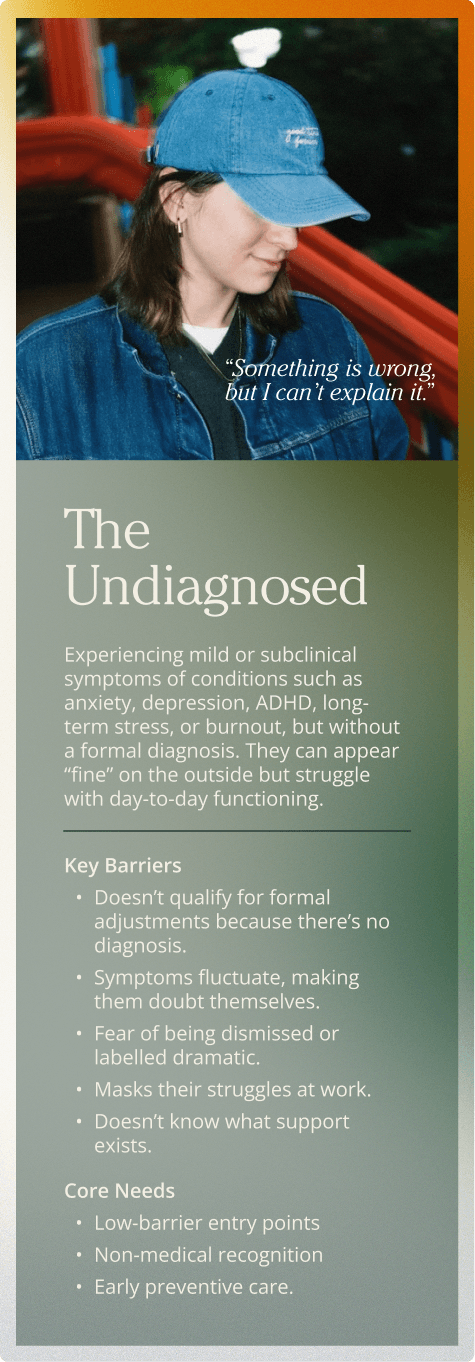
Based on the highlighted issues of systemic and psychological barriers and widespread burnout that was covered in the background, this project looks at groups of individuals that fall within the grey zones and blindspots in the care system and policies. This are typically those who do not qualify for formal support but still struggle to maintaining areas of their wellbeing, which then affects the other areas of their lives.
The In-Betweeners & the Misfits
Working Professionals
Tower Hamlets, London
At Risk of Burnout
Due to life circumstances such as
major life events
recovery from illness
high stress levels and burnout
informal caring duties
In the Interstitial Spaces of Care
Due to non-visible, fluctuating, or low-needs conditions such as:
- some long-term health conditions
- some neurodivergent conditions
- subclinical conditions
Due to systemic issues such as:
- overstretched healthcare system that inevitably prioritises urgent cases
- Barriers getting diagnosis
The Archetypes


As-Is Journey
To illustrate the barriers and struggles faced by these individuals, an as-is journey charts the their experiences through a workplace setting under constant high stressors.
This journey was created based on the experiences and accounts of the individuals and community members during the research. Additionally this was shared with the attendees at Neuroinclusive Play Collective to ensure that it is representative and reflective of a typical journey.

Stakeholders
Discovery stages exposed the complex health and care system within the country, with constant changes adding another layer of convolution. In this segment, possible stakeholder excluding the service users that were previously mentioned, are mapped into three levels; macro, messo, and micro.
National and System-Level
MACRO
NHS England
Role
Strategy, policy alignment, prevention agenda
Potential Contribution
Providing frameworks:
Enables integration of service within prevention agendas
Supports legitimacy and scalability
Department for Work and Pensions (DWP)
Role
Funders of Access to Work and Able Futures
Potential Contribution
Mental health support for employees
Employer training
North East London Integrated Care System (NEL ICS)
Role
Place-based health partnerships
Potential Contribution
Governance structure for localised rollout
Integrates NHS + Local Authority + VCSE
Supports adoption across boroughs
North East London Integrated Care Board (NEL ICB)
Role
Commissioning and oversight
Potential Contribution
Resource allocation
Connects the service with wider network
Primary Care and Health Delivery Partners
MESSO
Primary Care Networks (PCNs)
Role
Local frontline health units
Potential Contribution
Identify early signals of burnout
Provide social prescribers, care coordinators, health coaches
Joint delivery of referrals and personalised plans
Social Prescribing Link Workers
Role
Social Prescribing Link Workers
Potential Contribution
Navigation into community groups, activities, wellbeing programmes
GP Practices
Role
Everyday health access points
Potential Contribution
Early identification of individuals needing support
Community, Voluntary and Social Stakeholders
MESSO
Tower Hamlets Council for Voluntary Service
Role
Infrastructure organisation for local VCSEs
Potential Contribution
Linking with community partners
Facilitate community-based delivery
Tower Hamlets Carers Centre
Role
Support unpaid and informal carers
Potential Contribution
Identify carers hidden within the workforce
Refer to service
Creative Health Champions & Creative Health Associates (NCCH)
Role
Creative wellbeing initiatives
Potential Contribution
Provide creative, non-medical wellbeing activities
Support the delivery of early-intervention tools
Enable community-rooted wellbeing pathways
Workplace and Employment
MICRO
Employers
Role
Entry point for preventative support
Potential Contribution
Offer service
Offer flexible working arrangements
Have dedicated roles to support service and workplace culture of care
Provide access to staff for wellbeing planning
HR Teams
Role
Internal wellbeing governance
Potential Contribution
Identify staff at risk
Advocate for adjustments
Support roll-out of wellbeing planning tools
Integrate into HR processes
Able Futures / Access to Work Providers
Role
Mental health and employment support
Potential Contribution
Free training for employees
Employee support
Employer training and resources
Co-Designing
A core methodology of the project is embracing lived experiences and giving individuals the space to share in a safe and non-judgemental space. Aside from organising one-on-one sessions with participants, often these dialogs are already happening around us through support groups and organisations.

Wellbeing Cards
Players were instructed to ranks the wellbeing dimensions from most important to least. This helps them reflect upon and visualise what is important to them as they move along the session.

Problem Tokens
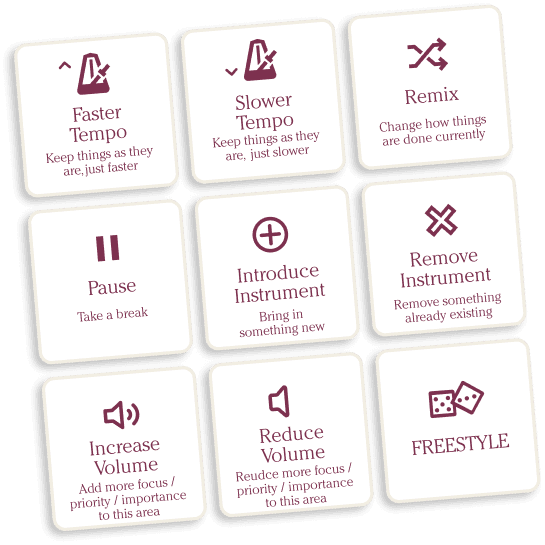
These tokens were used to state the issues they were facing in each systemic layer. Familiar phrases like ‘on mute’ which was used to describe low awareness and visibility. A ‘freestyle’ token was also included for participants to utilise when there is no suitable token that represents their experiences.

Solution Tokens
The Solution Tokens also utilises the same language and theme. For example, words like Tempo’ and Volume’ was used to describe pace and priority respectively.
Warming Up
The session began with a warm up where each participant shares a song that describes their current rhythm. Then, they were asked to share another song that reflects them when they are thriving, in-tune, and in-sync with themselves.
This gives each participant to hear the contrast and disparity between their current rhythm and when they are at their best.
Using music also helps to break the ice by setting a fun and casual tone, and gently nudging each participant to be more open during the session.

Composing their rhythms
The mismatch between the two songs for each participants act as a metaphor for the gap that links their current state of wellbeing to their best. Using this, the participants were then instructed to make changes to the rhythm through the tokens, identifying problems they faces and what they need to do to solve it.


Participant B
Participant B, a returning participant, talks about time scarcity, constant pressure, and the emotional weight of holding multiple responsibilities at once. He describes an ongoing struggle to balance it all with little room to pause or recover. He expressed that what he needs most is clarity, direction, and guided options.

Participant D
Participant D’s reflected on her relationship with work and life that is shaped by past experiences, overstimulation, and emotional volatility. She described past periods where stress turned into shutdown, isolation, and crying through workdays during lockdown. She reflected on her need for relief from intensity. She desires environments where slowing down is not punished and grace rather than guilt.

Participant F
Participant Y often feel that he must fit into societal’s expectations. He highlighted difficulty with transitions, executive overload, and navigating fluctuating motivation. As someone who is juggling personal constrains against expectations, he expressed how easily one disrupted piece throws everything off. He talked about needing clearer structures, but not rigid ones as predictability helps him anchor, but excessive demands cause paralysis. He reflected on adaptable, functional supports instead of generic solutions.
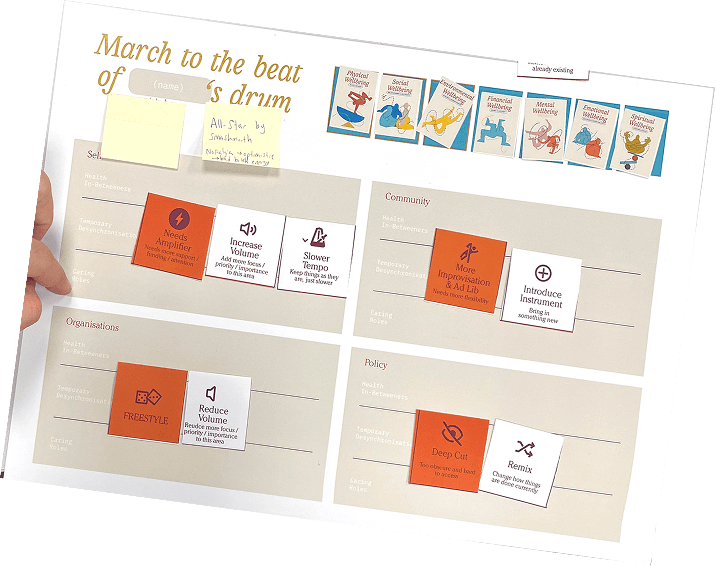
Participant G
Participant Z expressed his tendency towards energy depletion. He spoke about the cognitive labour of managing life transitions and balancing internal expectations with limited capacity. His inputs revealed a desire for gentler environments and meaningful connection, but contradictory to that, he often push through exhaustion rather than acknowledging his own limits.
Project Statement
Despite coming from different contexts, people described similar blind spots in current systems like barriers to accessing early support and the emotional and logistical labour of navigating wellbeing alone. These patterns reveal a shared gap in how support is recognised, accessed, and sustained for individuals who fall into the grey zones of care.
These insights, together with defining the service users and archetypes form the foundation of project direction. They point towards a need for a service that acknowledges fluctuating life rhythms, bridges fragmented care pathways, and offers earlier, gentler, and more personalised forms of support. This leads to the following project statement.
Designing Social Innovation for Today
How might we
enable more responsive and equitable systems of care for working professionals who are at risk of burnout but remain unseen within existing workplace and healthcare frameworks?
Additionally, with the long-term goals of the health and care systems, the service has to be able to adapt and align to the strategies of NHSE and local ICBs.
Designing Social Transformation for the Future
What if
the future of care moved beyond clinical boundaries to holistic integration through scalable, community-anchored models that flex to the realities of life?
DEVELOP
Developing the Service Solution
Following the discovery phase, it became clear that the system’s challenges and people’s lived experiences highlights a mismatch. Diverging and Developing builds on these insights by exploring multiple directions before refining a more focused pathway. This chapter presents the explorations, provocations, and design iterations that helped clarify the project’s position within this ecosystem
Ideating and Diverging
The ideation process drew inspiration from lotus Blossom mapping approach, Venn diagrams, and systems thinking to explore ideas that span workplaces, communities, and care networks. Starting from the core opportunity areas, ideas were branched outwards as interventions in response to them.

Prioritisation Matrix
To determine which ideas were most feasible and impactful, a prioritisation matrix was used. Ideas were mapped according to effort and impact to identify suitable interventions and also control the project breadth. This ensured that the emerging concept is both realistic and aligned with both the system and project capacity.
Clustering
After assessing the priority of the ideas, they were then grouped into coherent clusters to understand how they could form integrated components of the service. These clusters represent distinct layers of support.
Labelling each cluster to reflect its function also helps to form the service structure and gives a clearer picture as to where it comes in and the stakeholders involved.
From this, a first draft of the service mapping was created to be discussed with key stakeholders for feedback and refinement.


Weaving into Ongoing Efforts
NHSE and Tower Hamlets already hosts a myriad of health and care support services so it is important to work with existing assets and not duplicate efforts in interest of safeguarding resources. The strategies implemented through the LTP carries a lot of potential to make radical and impactful outcomes.
The issue mainly lies in the convoluted network which limits visibility and accessibility to them. As such, this service idea should build on the existing system, simplify pathways, make entry points more visible and cultivate a culture of care.
Consulting
To gain deeper understanding of existing processes and gather insights beyond the available reports and data online, I reached out to Alison Robert, a partnership manager at Tower Hamlets Council for Voluntary Services (THCVS). A simplified mapping of the current and proposed pathways were also discussed to review the feasibility and identify potential challenges and factors to consider in future iteration.

Tower Hamlets Council for Voluntary Service (THCVS) was originally identified as a possible service provider due to their unique position in linking with VCSEs, statutory organisations, and the community. This role aligned with the initial ideas for the service as a main component of it is the integration of workplaces into existing health and care networks.
From the conversation with Alison Robert, a partnership manager at THCVS, assumptions were disproven and insights were shared that could then be utilised to build the iteration of the idea.
Key Discussion Points
Clearer Understanding of Social Prescribing Pathways, Capacity and Systemic Constraints
Alison clarified some confusion about the pathways for Social Prescribing that arose from the unique implementation in each borough and the multitude of information found during the secondary research.
Contradictory to what was discovered during research, many referrals to Social Prescribing only happen when problems are already moderately severe and not at an early preventive stage.
This is because of the limited resources the service has against the multiplying amounts of new referrals, therefore the criteria was unofficially tightened.
Furthermore, the voluntary sector organisations gets limited funding and have little capacity to take on extra tasks like gathering and reporting feedback, creating a disjointed loop between referral and outcomes. She suggested the Joy platform as a possible leverge.
There are only around 8–16 full-time Social Prescribing Link Workers in the borough, serving up to 30,000+ potential referrals annually.
Furthermore, the voluntary sector organisations gets limited funding and have little capacity to take on extra tasks like gathering and reporting feedback, creating a disjointed loop between referral and outcomes. She suggested the Joy platform as a possible leverge.
Workplace Wellbeing and Organisational Responsibility
A simplified mapping of the service idea (Fig. 7D) was shared to compare against the current system. Of some of the ideas shared, Alison provided feedback on the ‘Wellbeing Advisor’ role that was proposed. She mentioned that many workplaces provide wellbeing support (e.g. Employee Assistance Programmes or 24-hour counselling), but employees often are unaware. She suggested to explore the workplace efforts on wellbeing to identify possible points of integration.
She also stressed that defining specific user groups to tailor to their trigger points is key to preventative intervention. The current user group identified was too broad to make relevant solutions that would be impactful. On top of that, she acknowledge the complexity of the health and care system across borough which makes discovering and access difficult for a resident. She advised creating simplified pathway to access such services.


As Alison Robert suggested, a meeting was organised with a workplace staff member that overlooks employee wellbeing to discover the existing active steps employed and structures in place.
Amanda Leat, a people lead at Fletcher Priest Architects, shared the extensive practices at her firm:
Concrete Supports & Benefits
Private medical cover, with included gym membership and app access like Calm, Strava and other wellbeing tools.
Employee Assistance Programme (EAP) which provides 24/7 line, emergency and longer-term counselling, up to 12 therapy sessions per issue per year, legal and financial advice.
Peppy Health - an app for fertility, menopause, men’s health, early years.
Munny - a service for financial counselling and advice
Architects benevolence society - service available to not just architects, but also everyone else who works at the architecture practice
Access & Awareness
Benefits available from day one, not just after probation period.
Induction at beginning of employment and various sessions throughout the year.
In-house drop-ins by partners (eg Peppy).
Peer signposting culture.
Listening Infrastructure
Wellbeing office hours (Fully-booked in the first week of launch)
Wellbeing room for prayer, meditation, quiet.
Implementing monthly pulse checks for agility.
Personalised Development Planning
Conversation with employees to understand what hey need and what works for them
Link with university disability advisers (for new grads)
Draws on Cognitive Behaviour Therapy (CBT) style pattern spotting and reframing.
Mediation between employee and line manager to improve communication cycles.
Her role at the firm was a result of a company-wide survey showing a need and demand. After she was hired, she revealed that she requested for support from upper management in order to create more meaningful impact, and this resulted in the wealth of measures to look after their employee and improve wellbeing.
Amanda also detailed on her belief that investing in people is worthwhile. Many companies think wellbeing support is too costly, but that’s a false economy to think that operation costs can be saved through that. Investing in wellbeing is an act of preventative care for both the organisation and the employees.
“Financial stress is huge. Everything in the world costs more these days. We're in London – housing here is ridiculous, food prices are going up, travel is going up, everything all the time.”
Amanda also advocated for the need to implement a holistic strategy that also cares for the workers beyond their professional duties as the areas of wellbeing influences each other. She acknowledges external factors like the high cost of living that means money can be a huge cause of worry or stress. She integrated this consideration into the list of support for their employees.
In her experience, the fear of stigma often prevents individuals from disclosing health conditions or personal struggles, which limits their access to support. This challenge is compounded by line managers who may lack the skills or confidence to respond appropriately. Amanda emphasised that training is essential to build a consistent culture of care within workplaces.

“When I first started, I, I introduced a wellbeing chat space. I just sat in the room and you can come talk to me. Every minute was filled. I had people queuing up outside. People wanted to come talk about things”
Overall Insight
The need for a clear and human point of entry
The uptake of services are not because of the lack of desire for them, but it is because of the struggle to navigate existing systems A single, relational point of entry could reduce confusion and make support more accessible.
Importance of financial and employment security
Financial strain repeatedly emerged as a primary pressure that influences a person’s overall wellbeing.
Bariers on all sides
Problem lies at all ends; individuals hold fear of stigmatisation, workplaces lack investment in wellbeing and community organisations lack resources to deliver effective services.
Revised Flow of Proposed Service

Changes Implemented
To create accessible entry point to support but not put additional strain on existing services
Seed more place-based wellbeing champions within workplaces through trainings, to be deployed as main person of contact, with SPLWs (Social Prescribing) and VRCs (Access to Work for Mental Health) coming in only when needed.
Build a strong culture of at work and at various touch points. Offer an arsenal of support services as a preventative effort and only escalate to more resource-hungry pathways when needed.
To support financial and employment security
Support services should also include financial advice and tools.
Offer flexible work schedules that allows companies to retain talent while employees can reduce working hours while still retaining income.
Coproduce leaving and return pathways for those who choose to take extended leave from work (sabbatical). This reassures that there are plans in place for their return.
To build service that is relevant to target users
Narrowed down target service user to employees within the Aldgate Connect Business Improvement District (AC BID). Business Improvement Districts are alliances of local business in an area that join forces to improve their environment (Greater London Authority, n.d.).
To facilitate feedback loop and streamline Social Prescribing
Leveraged an NHS-approved Social Prescribing Platform, Joy, and proposed a new product for end users.
Further Validation
The conversation with Vicky, the CEO at THCVS, confirmed that navigation and visibility and funding are the two biggest blockers. However, she alerted that THCVS focuses on infrastructure and facilitation, not delivery of service.
This means that they cannot take on the role of being the service provider, or employ additional advisors to serve this service. However, THCVS would be more suited as a coordination partner than a delivery body.
Furthermore, Vicky recommended to look at organisations with the resources to deliver the service so that these advisor roles can be housed under these funded systems.
“THCVS is infrastructure. We support and convene, but we do not do direct delivery.”
However, Vicky shared that GP practices and hospitals now have Social Welfare Advisors as part of the new ICB strategies and they have similar responsibilities to the proposed advisor roles. Rather than duplicating efforts, this presents an opportunity to strengthen the connection of the service with the rest of the health and care network. This also opens opportunities to explore training models for workplace HR or wellbeing champions in partnership with these advisory services.
The proposed idea of exploring Aldgate Connect Business Improvement District (AC BID) as a possible service provider seems promising for piloting workplace partnerships, especially if the cost is absorbed by employers or national programmes. The service can be positioned as a cross-sector bridging initiative, connecting employers, funded government programmes (like Able Futures), and the VCSE infrastructure.
The research into the Social Welfare Advisors as mentioned led to the update announcing that job advisers that will be embedded in GP surgeries under the Connect to Work programme. The purpose of this movement is to help sick or disabled patients to get into work, however London is not within the delivery area as of yet (HM Government, 2025).

The communications with Tony, the Volunteer Manager eventually led to a session with the Carer Champions - a group of carers that CCTH regularly works with and consults to co-produce . The group consists of current and former carers, all of whom come from different background, responsibilities and age range.

The session was split between open unstructured conversations surrounding their experiences with processes (in this case, creating a Lasting Power of Attorney) and a workshop to rank preferred details of solutions like tone of voice.
The carers highlighted the need for guidance. This can be in the form of simple, step-by-step information that are broken down into small doable actions, someone to consult to ensure that things are done correctly, or a trusted person to guide them throughout a process. They mentioned the complex processes adds on to their mental load and causes them to feel overwhelmed.
Terms, jargons, and names also adds onto the confusion as they struggle with distinction between those. A unified platform that clarifies and connects those terms can ease the burden of understanding. Additionally, that platform can serve as a multi-touchpoint support that unifies siloed tools to reduce the complexity. This can help carers to move through the wider ecosystem with less friction.
Emotional support was another important theme. Carers discussed how difficult or sensitive topics can be challenging to navigate alone, and emphasised the value of having a trained and trusted advisor to support these conversations. They also shared that peer examples and real stories feel more credible and comforting than official information, highlighting the importance of lived experience in building trust.


The workshop was designed around a craft session that gave participants a comfortable space to share about their experiences working and dealing with stress, pressure, or burnouts. As it can be a heavy topic to discuss, the workshop was intentionally set in a relaxed environment with no rigid schedule to follow.

Conversations
The flow of the session progressed naturally with participants chiming in with their experiences. Most participants reflected on their struggles and shared feelings such as guilt. It was interesting to note that they did not mention seeking support or help until it was prompted.
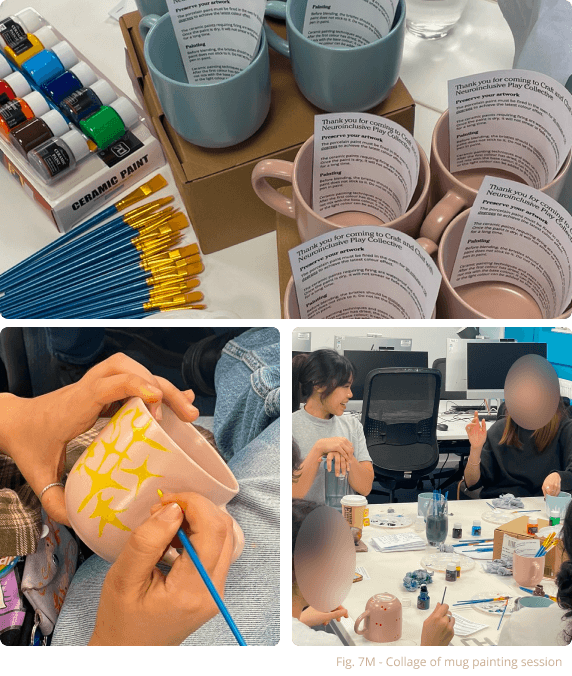
Validating As-Is Journey
The As-Is journey was shared with the participants to assess if it is reflective or representative of the general experience with burnout, or symptoms of burnout.
In general, the participants vehemently agreed that it reflected their experience. They detailed, however, that the first two stages were more common and they sometimes cycle between the stages. This informed the staged where people need most help.

Testing Prototypes
After sharing the as-is journey, participants had a better idea of the issue the project is trying to tackle. They were presented prototypes of the JoyforMe platform and interacted with it.

In Summary
Across the individual conversations with participants, sharing spaces with community groups, discovery on the systems in place and consultation with on-ground practitioners emerged reoccurring themes and revealed gaps. These useful insights can be translated to design opportunities to create impactful solution that addresses the unique needs of the people.
Despite the wide range of background and lived experiences, overlapping themes repeatedly emerged: limited capacity and resources within services, accessibility to support, and increasing pressure on individuals to self-manage their wellbeing. These insights revealed both structural gaps and unmet needs that persist across different communities.
Although the direction of the service had to evolve in response to new learnings, the core challenge remained. This understanding further refined how the service is shaped, ensuring that the next stage is grounded in real needs of today.
DELIVERY
The Service
Care for All is a place-based wellbeing service embedded within workplaces. It expands, enhances, and streamlines existing care systems by making them accessible through a single touchpoint - Wellbeing Personnels located directly in the workplace.
These Wellbeing Personnels improve access to support by co-producing Personalised Wellbeing Plans with employees at the start of their employment, which can be reviewed and adapted over time. Rather than waiting for crises to occur which is a reactive, “fixing” approach, the service adopts a preventative model, supporting individuals to sustain healthier and more sustainable life rhythms.
The service also champions shared decision-making and promotes individual agency through the JoyforMe platform that enables employees to take an active role in managing their wellbeing and to stay connected with a system of care that moves in sync with their lives.

This proactive support creates a fertile environment to foster a culture of care by reimagining who gets access to care, how it is delivered, and how it is accessed. Care for All builds the right foundation within workplaces by having a library of support services as part of the Care Culture strategy made available through various life circumstances, whether its preventative care or a respite when in crisis. It also connects existing schemes with local networks in Tower Hamlets, giving individuals direct and seamless access to the support available. The service allows individuals to craft their pace and rhythms by embedding flexibility, rest, and community into the fabric of daily life.
This is supported by the Seeding Scheme that trains and embeds local experts to relief oversubscribed healthcare services and decentralise services. These experts present as Wellbeing Personnels in workplaces, filling in, and bridging the gap of a vocational advisor (of the Access to Work programme) and Social Prescribing link workers.
Care for All also targets a common stressor of a Londoner, financial security, through the Rest and Resync scheme that allows one to recalibrate without risking their livelihood. The pathway offers part-time placements during sabbaticals preserve flow of income, and a phased return-to-work plan to assure job security. The service is designed to scale, beginning with a pilot in Tower Hamlets before adaptation across other regions and workplace contexts.


From an asterisk that hides the fine print to a full stop that offers reassurance. Care for All is designed to nurture a culture of care that supports everyone.
In order to achieve that, the Care for All has to meet these aims:


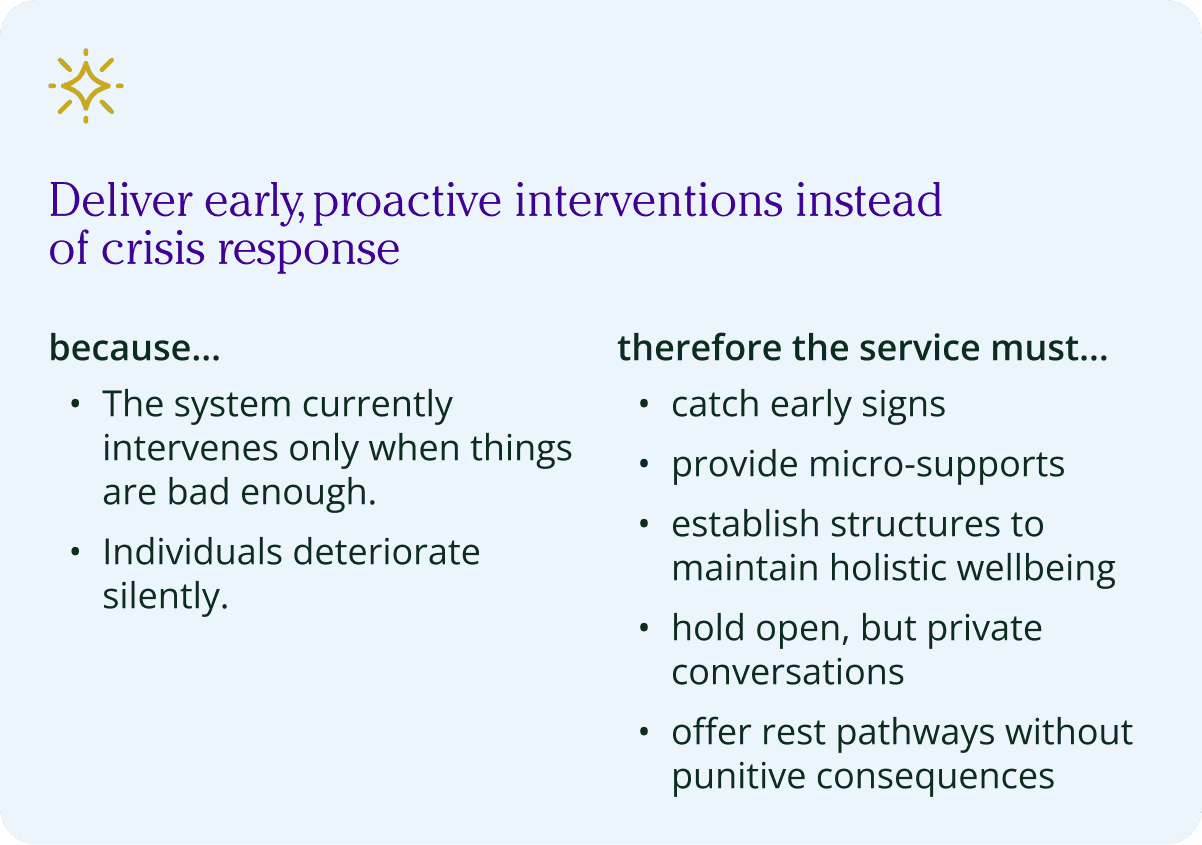

Network Overview
Overview of how the bigger health and care network is connected to workplaces and individuals.

Service Architecture within Workplaces

Service Flow within Workplaces
The Care for All system within workplaces consists of two main components that creates a local ecosystem of support. This is made possible through seeding trained experts in-house.

To-Be Journey
The as-is journey is given a transformation to reflect the user’s experience before, during, and after receiving the services. The desired outcome is to ultimately cultivate a culture of care where each individual feels looked after by their community around them, especially when life gets hard.

Prototypes
JoyforMe
The JoyforMe platform is an extension of an existing NHS-approved platform, Joy, to include the individuals who use community-based and wellbeing support, as well as vocational support.
While Joy currently focuses on enabling healthcare professionals to manage referrals, cases, and community networks, a critical gap remains for the end users of these services to understand, navigate, and act on their own wellbeing pathway.
The absence of a user-centred entry point limits self-agency and places additional administrative demands on link workers.
This gap presents an opportunity for Care for All to introduce JoyforMe: a new digital product that complements the existing suite of Joy tools while enabling individuals to manage their own Care for All journey.

Why
Economic systems prioritise measurable productivity over wellbeing, leading to the systematic undervaluation of unpaid care work. This work, largely carried out by women, is essential to societal functioning yet remains invisible in economic assessments, reinforcing gender inequality and limiting progress toward a more inclusive and equitable economy.
How it Supports Individuals
JoyforMe acts as the digital front door to Care for All, giving individuals
A personalised view of their Wellbeing Plan
Clear next steps, broken down into manageable actions
Integrated scheduling for appointments, activities, and check-ins
Tools to track wellbeing rhythms and reflect on progress
Direct communication with their Wellbeing Personnel
Access to a wealth of local services and community activities
How it Supports Practitioners and Systems
JoyforMe connects existing fragmented services and increase visibility and accessibility to them. As a result, it also benefits the wider system through
Reducing administrative burden on VCSEs and SPLWs
Creating a feedback loop for providers to continuously improve services
Improving data visibility for local care networks
Strengthening continuity across services and sectors
Aligning care plans between healthcare, community services, and the workplace
Frictionless Integration
Users simply sign in with their work email, which is already linked to their wellbeing plan and support network. Once logged in, all relevant information is automatically reflected, allowing individuals to continue their journey without additional setup or repeated forms. This streamlined access reduces friction, supports ease of use and ensures that users can focus on their wellbeing rather than navigating administrative processes.
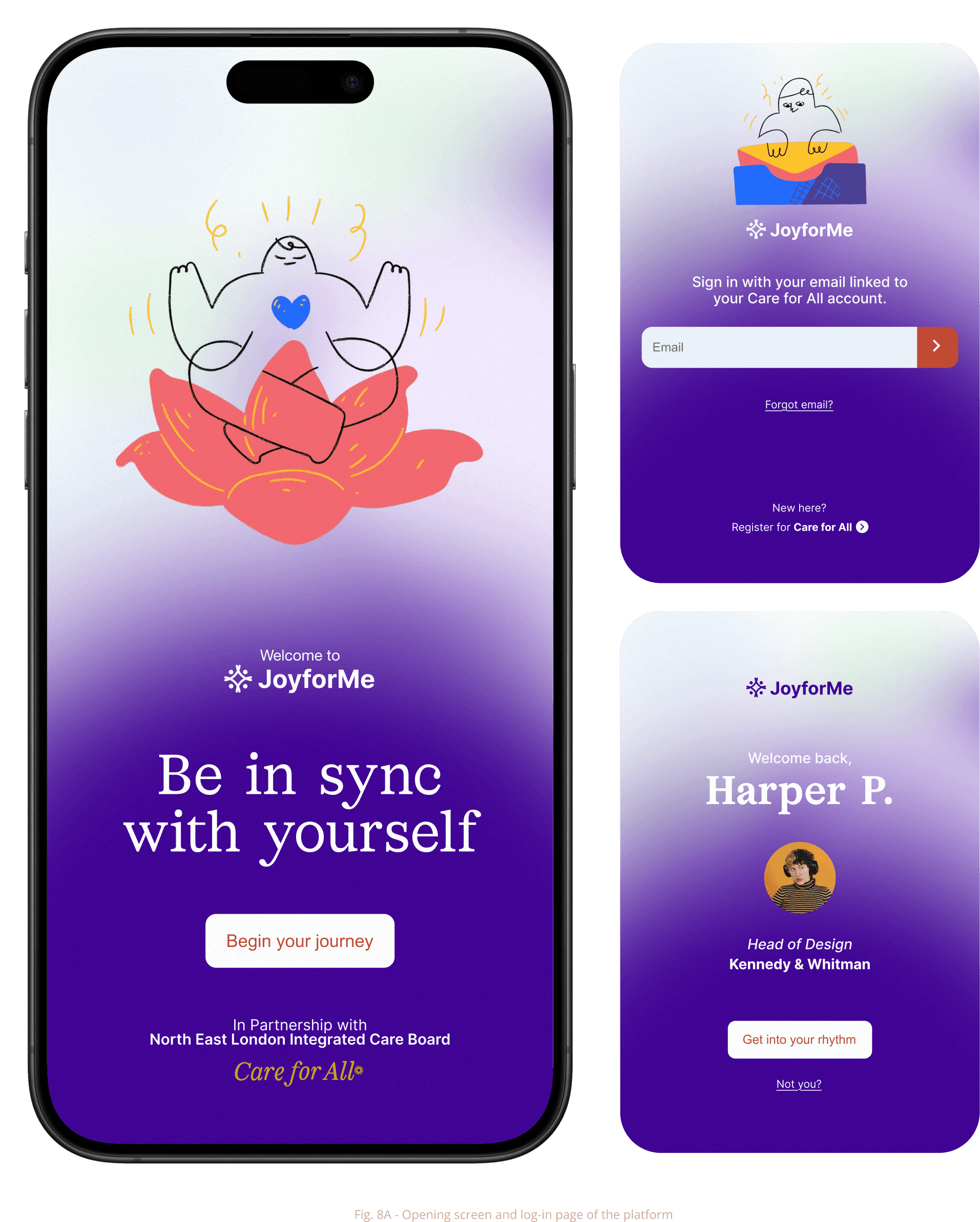
Dashboard
The dashboard serves a an intuitive and comprehensive hub that displays important information upfront, reducing overwhelm.
Short, medium, and long-term plans are kept visually simple while still allowing users to be on top of their plans and progression easily.

Keep Tabs
Upcoming activities are displayed in a clear, manageable schedule, allowing individuals to see what is next and plan their journey as they go.

Smart Suggestions
The platform also draws trends and insights from the user’s feedback and recent engagement. These patterns help individuals recognise what supports them, where they may be struggling and how their wellbeing fluctuates over time.
Smart suggestions then offer personalised recommendations based on these insights, such as relevant activities, moments to rest or opportunities to rebalance. Together, these features provide gentle guidance that supports sustained, preventative care.


Marketplace for Services, Advice, and Community Activities
The library of services leverages Tower Hamlets Together and Tower Hamlets Connect’s extensive directory to create a streamlined point of entry to the health and care network in the borough.
In addition to the easy-to-browse marketplace, users will also be shown tailored recommendations based on their preferences and activity history to meet their wellbeing goals.
Through this platform, users can request to be referred for the selected listings, directly with their Wellbeing Personnel.
Guidance Without the Waiting List
Users can easily contact their Wellbeing Advisors for matters related to their care journey without needing to book appointments or wait in long queues. The chat feature offers a direct space to ask questions or seek guidance.
To further reduce waiting times and reliance on staff capacity, an automated assistant can respond to common queries and direct users to relevant information.
Clear reminders also guide users on the appropriate use of the chat function, including signposting emergency services when urgent support is required.

Copiloting Decisions
Users can request referrals directly through a simplified and guided process, instead of navigating multiple systems or attending additional appointments. This reduces administrative friction for both users and practitioners while ensuring that people are linked to the right support at the right time. Advisors can review and approve requests efficiently, creating a smoother and more responsive care journey.

Feedback Loop
JoyforMe introduces an integrated feedback system that makes it easier for individuals to share their experiences with services they access.
Feedback is captured in a simple format that reduces the burden on VCSE organisations, who often lack the capacity to manage their own monitoring processes. This continuous flow of insights supports service improvement across the ecosystem and helps spotlight unmet needs.
On the other hand, tracking the user’s mood and emotional rhythms can be used aa a moment of reflection, and over time, shows trends and patterns. This can also act as a feedback to the system to recommend more similar activities that works for the individual.
Additionally, users can rebook immediately after without repeating lengthy approval processes. This reduces delays, maintains momentum in their care journey and minimises the administrative load on practitioners, enabling individuals to stay engaged and supported with minimal effort.
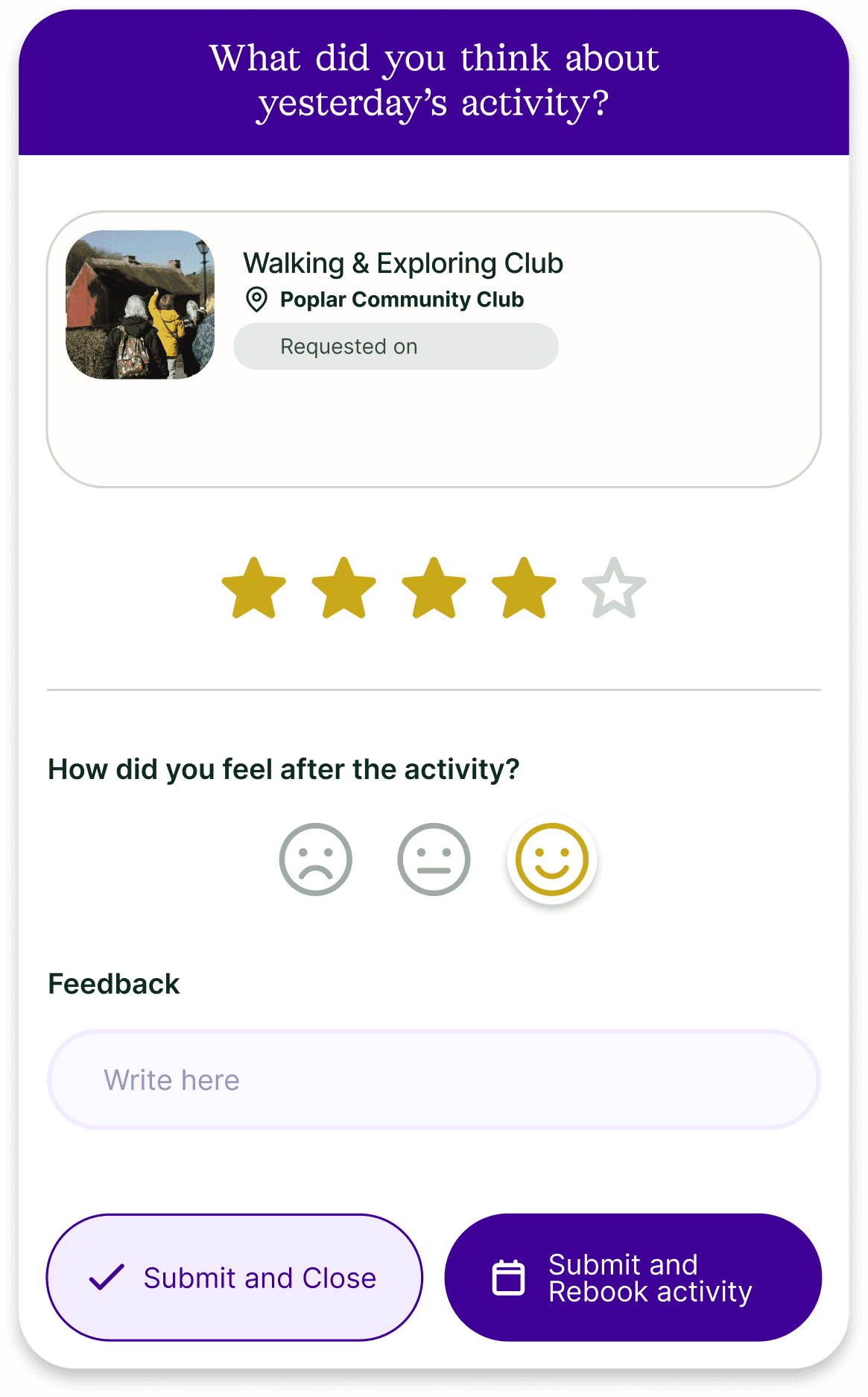
Employer Toolkit
The Good Thinking is an online service that was supported by the NHS, providing Londoners to a wide of free NHS-approved wellbeing tools and resources. However, with the changes to the the funding, the service was announced to shut down in January 2026 (Good Thinking, 2025). While it has helped over 800,000 people, the closure does not mean that the efforts has to stop there. The wealth of resources and materials can be adopted by NEL ICB to enrich the Care for All programme instead of duplicating efforts, saving cost and resources.

Signposting
Care for All can offer a holistic toolkit for employers that curates useful information, resources, and services to enhance and broaden the workplace wellbeing support and internal communications activities.
This can include signposting to other organisations like Mental Health UK for bespoke support from their partnership team, to a list of NHS-approved apps for their employees to use, to workbooks and guides.

Posters and Communications Materials
The toolkit also provides communication materials like templates that can be used as printed poster or even communications such as email newsletters. This frees up the time of the HR team or Wellbeing Personnels so that they can focus on their engagement with the employees.

Workbooks
The workbooks adapt existing ones by The Good Thinking, updating its contents to reflect relevant or up-to-date information. It serves as a low-cost, high-impact solution that educates and equips individuals while also aligning to the LTP constrains.
These workbooks can be disseminated at various locations across the workplace for employees to pick up, given out during wellbeing drop-in sessions, or shared digitally on their relevant platforms. This requires low upfront and maintenance cost, manpower, and also resources, while the end users can utilise them at their own time and/or anonymously.


Service Mapping
The service map presents the wider network of the Care for All service. It shows the key actors and facilitators, and where they come in. The map also shows how decentralising services and equipping local communities with tools and skills can relief the capacity constrains in primary care networks.

Service Blueprint
Care Culture and Everyday Support

Rest and Resync

Seeding Scheme

IN SUMMARY
Conclusion
Grounding Methodologies
Building for Life Rhythms set out to understand why many people feel misaligned with the pace and pressures of contemporary life, and how existing care systems often fail to recognise or respond to these lived rhythms. Research across communities, organisations, and policy landscapes revealed overlapping challenges, that is, fragmented support structures, overextended services, barriers to access, and cultures that prioritise productivity over wellbeing. These issues informed the design of a relational, preventative, and rhythm-attuned service model that aims to bridge gaps between individual needs and systemic realities