

On the theme of Museum of Futures, this speculative design brief focused on designing for the future of community agency and immersive technology.
Institution
MA Service Design, University of the Arts London
Course Unit
Design Futures
Year
2025
Project Context
Postgraduate Project
Collaborators
Alisa Mahat, Andrina Syarifa, Diksha Ashok, Smriti Sarath
A collaboration with Centre for SocioDigital Futures (CenSoF) at University of Bristol.
The postgraduate MA Service Design students at University of the Arts London collaborated with the Centre for SocioDigital Futures (CenSoF) from University of Bristol on this Design Futures unit led by Marion Lagedemont and Silvia Grimaldi. In the summer of 2025, the teams held a public exhibition showcasing their work on the speculative future. Watch the short film here:
“ With us, not for us. Stay connected, stay loud, and stay Kingsley.”
Set in a future shaped by widespread urban redevelopment, the Kingsley neighbourhood faces the gradual erosion of its cultural identity, collective memory, and community networks. In response, residents establish the Kingsley Agency for Collective Identity (KACI), a grassroots body dedicated to safeguarding the stories, values, and places that define their neighbourhood.
Operating as both a civic institution and a platform for collective action, KACI enables residents to challenge top-down redevelopment processes and actively participate in determining what should be preserved, transformed, or reimagined. The organisation represents a shift from consultation towards community-led stewardship of place.
The residents of Kingsley, hold that their stories, and emotional ties are as vital as the mortar and steel that shapes them. Their culture, history, and everyday ways of living are not collateral damage in the name of “progress”. They believe in place-based agency: that those who live there should decide what endures, what evolves, and what is never lost. They are claiming their narrative, amplifying their voices, and shaping the future of Kingsley.
The Promise: Manifesto
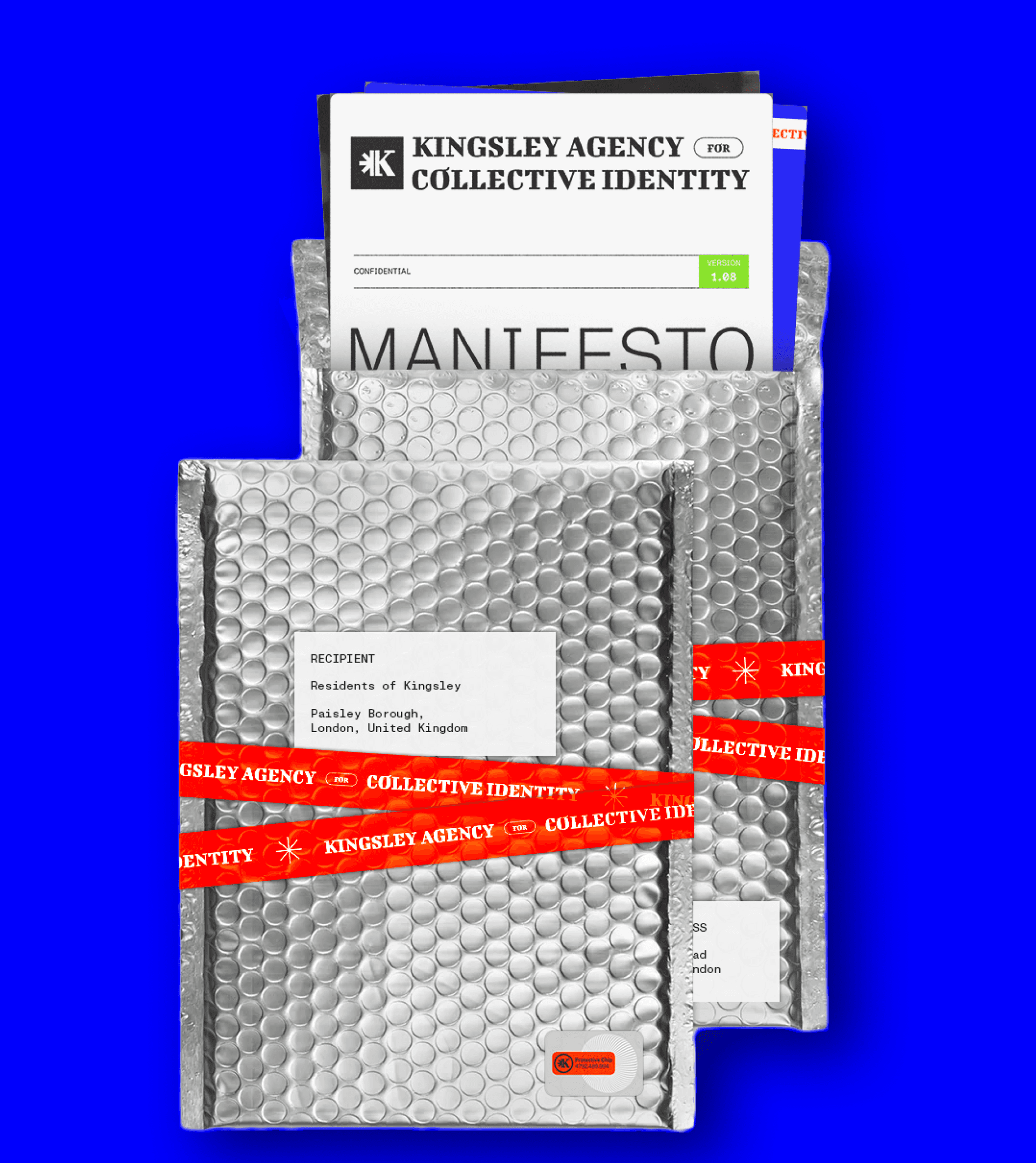
The movement was created to promote community agency through location-based geofencing immersive technology to strengthen neighbourhood identity and campaign against cultural destruction.
The Kingsley Agency for Collective Identity (KACI) manifesto is a call to action for every resident of Kingsley. It is a declaration of who they are, what they stand for, and what they demand from those in power.

This document outlines their beliefs, their vision for a Kingsley where development enhances rather than erases, and their principles that centre community sovereignty, cultural continuity, and radical hospitality.
It also details their demands to the Paisley Borough Council, asserting their right to be heard, to be seen, and to be included in every decision that affects their streets, their spaces, and their stories.
Community Tools

RE:R00T is a tactical, short-term geofencing activation designed to disrupt impending demolition or redevelopment plans that exclude community input. Initiated by the Kingsley Agency for Collective Identity (KACI), it targets culturally significant sites under threat, projecting community demands and shared memories directly onto the affected area.
Activated for 1-3 days, the RE:R00T device intercepts nearby devices, broadcasting stories, protest messages, and urgent calls for negotiation to anyone within the geofenced zone.
By compelling local authorities to confront the collective voice of Kingsley residents, RE:R00T forces a pause on progress until a transparent, inclusive dialogue is established between the council and the community.
In a city where cultural erasure is masked as “development,” RE:R00T ensures that the people’s stories are not bulldozed alongside the buildings.
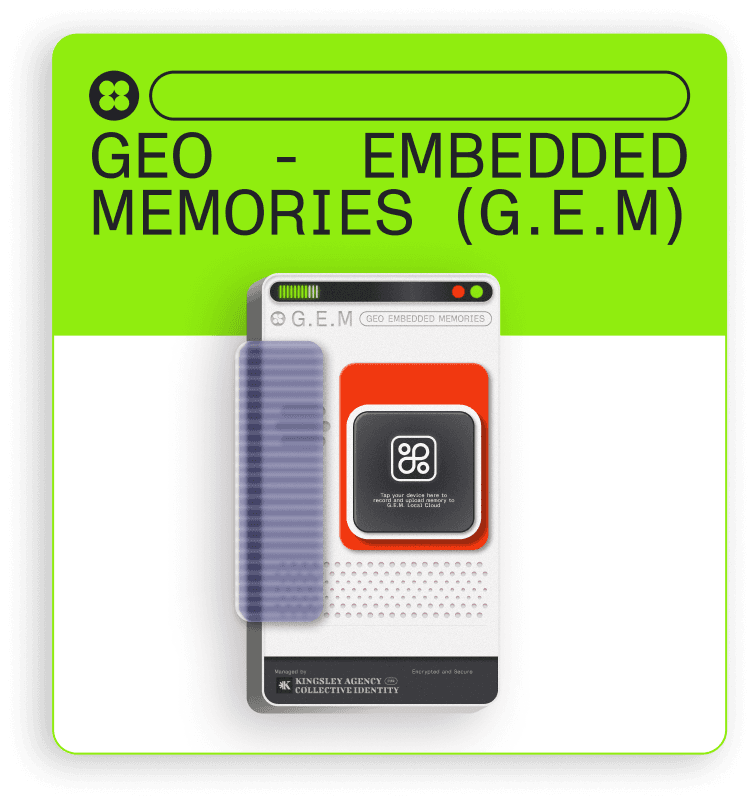
The G.E.M device is a neighbourhood-wide network of memory deposit boxes designed to preserve the collective stories, experiences, and cultural moments of Kingsley residents.
The aim is to remind residents that their neighbourhood is not where their house is, it is a place that holds important meaning.
It is accessible anytime, these devices are strategically placed on everyday objects, from lamp posts and benches to listed buildings and landmarks. capturing and archiving digital memories that residents choose to share.
Physical artifacts, such as heirlooms, photographs, letters, or mementos, can be deposited at the Library of Memories, a dedicated space within the public library.

The G.E.M Hot Spot Map is a dynamic, interactive tool that visualizes the density and distribution of memory deposits across Kingsley. Every G.E.M device installed on key neighbourhood objects such as lamp posts, listed buildings, benches, and landmarks that records stories, memories, and shared experiences contributed by residents.
Accessible to everyone, the map highlights areas with the most memory deposits, revealing neighbourhood sites rich in cultural and emotional significance. This visual data can serve as compelling evidence in advocacy efforts, reinforcing the value of specific locations and their importance to the collective identity of Kingsley.
By showcasing memory hotspots, the G.E.M Hotspot Map not only preserves the intangible heritage of Kingsley but also empowers the community to reclaim spaces at risk of being erased in the name of “progress.”
Action Plan

The Kingsley Agency for Collective Identity (KACI) is committed to preserving the cultural and historical integrity of the Kingsley neighbourhood while actively resisting exploitative development. This action plan outlines the strategic framework for community-led preservation and protest initiatives.
Objective
To mobilise and equip residents with tools and strategies to safeguard their neighbourhood’s cultural heritage, amplify their voices against destructive development, and maintain community agency.
Timeline
Month 1-2: Community Education & Device Installation
Month 3-4: Memory Collection & Library Establishment
Month 5-6: Initial RE:R00T Activations
Month 7-8: Protest Coordination & Training
Month 9-12: Monitoring, Evaluation, and Strategy Refinement
Evaluation
Collect feedback from residents after each initiative.
Assess the impact of preservation and protest activities based on changes in council responses and planning outcomes.
Review and adjust the action plan quarterly to maintain strategic alignment with community goals.
The Action Plan lays out a clear, step-by-step roadmap for mobilising residents, leveraging immersive tools, and negotiating with local authorities. It is divided into three strategic pillars:

Activation and Awareness Campaign

The Activation & Awareness Campaign is designed to spotlight threatened heritage sites, mobilise broad-based community support, and galvanise public and political will for preservation. Through a series of on-the-ground outreach and digital interventions, we aim to make Kingsley’s stories visible, heard, and impossible to ignore.
Letter to Residents
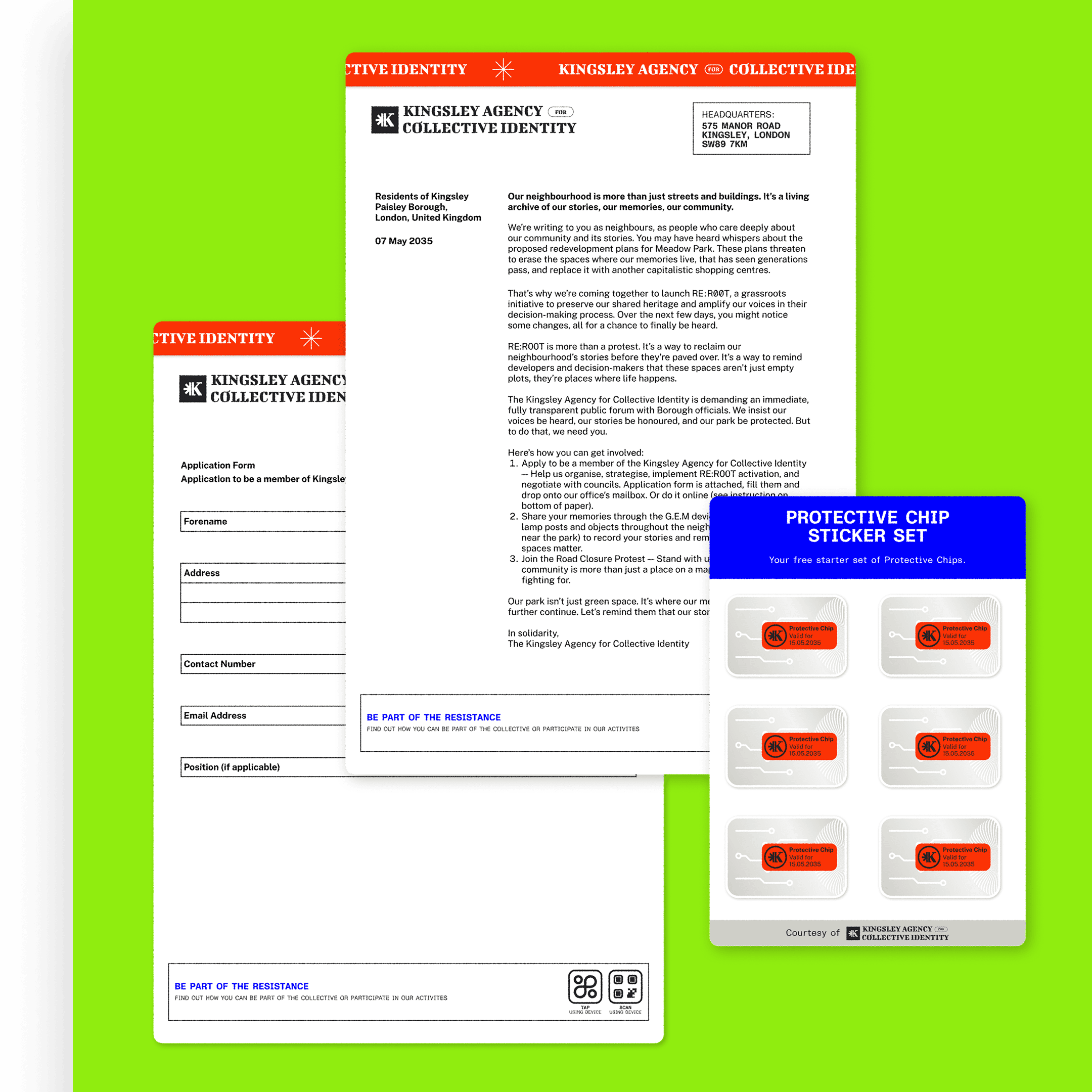
In response to mounting pressure from developers and planners, a confidential letter is distributed to Kingsley residents.
This letter acts as a blueprint for community action. It outlines the ways they can get involved using the tools and tactics available to amplify residents’ voices, from memory deposit devices (G.E.M) that transform neighbourhood objects into storytelling sites, to the guerrilla geofencing activations (RE:R00T) that demand accountability from local authorities.
Residents' Handbook

The Kingsley Agency for Collective Identity (KACI) creates the Resident’s Handbook to empower the residents of Kingsley to actively participate in the preservation and storytelling of their neighbourhood’s history.
This guide provides residents with essential tools, platforms, and actions to ensure they know what to do, where to do it, when to do it, with or to who they do certain things for, to make sure their voices are heard and their stories are preserved.
Ultimately creating a collective and planned voice to target authorities and urge on two-way conversation between dwellers and planners.
Online Platforms

The Neighbourhood Memory Archive is a digital platform developed by the KACI to document, protect, and advocate for the neighbourhood’s cultural heritage.
Designed in response to ongoing preservation efforts and RE:R00T activations, the platform provides residents with tools to actively participate in safeguarding their community’s identity.
Function as both a public memory repository and an advocacy tool, creating a shared record of community voices. Planners and authorities are granted controlled access based on the tier system, ensuring that the community maintains control over their narratives while using evidence-based advocacy to influence development decisions.
The Neighbourhood Memory Archive redefines heritage protection as a living, participatory process.
